





20mm Outdoor Porcelain Paving: What It Is and How It Is Laid
Why outdoor porcelain is 20 mm thick, how it is laid on gravel, grass, pedestals or a screed, the slip and frost points, and the five square metre rule.
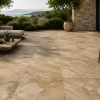
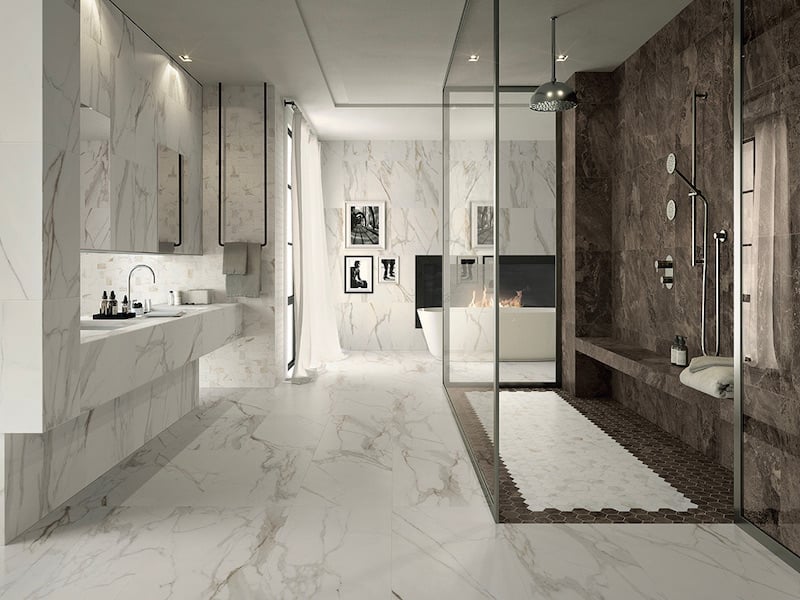
Outdoor porcelain paving is porcelain made thick enough to be a paving slab: usually 20 mm, about twice the thickness of our 9 mm and 10 mm floor tiles. It goes on patios, paths and terraces, and it is laid differently from a tile indoors. One thing first: we do not sell it. Our 11 porcelain tiles are 9 mm and 10 mm floor and wall tiles. This guide explains what 20 mm porcelain is, how it is laid, what to check, and where our tiles fit.
What makes it porcelain
Porcelain is defined by how little water it takes up. EN 14411, the European standard for ceramic tiles, defines a porcelain ceramic tile as a fully vitrified ceramic tile with water absorption of 0.5 % or less. The same standard covers tiles used for internal and external floorings, including stairs, and walls, and it asks for freeze-thaw resistance for tiles intended to be used where frost may apply.
Where our tiles fit
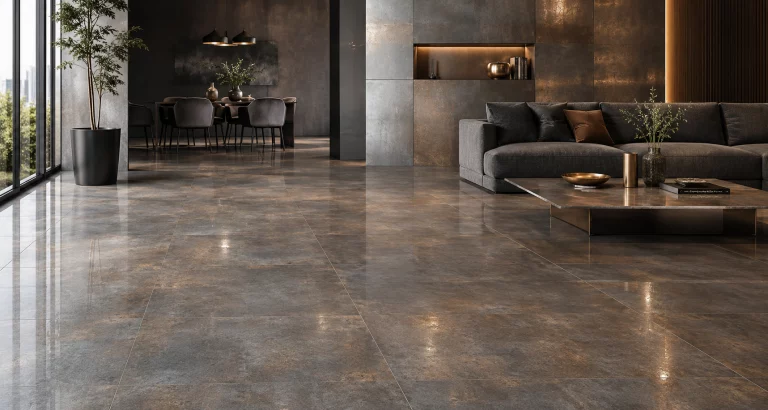
Our 11 porcelain tiles are indoor floor and wall tiles: all 600 × 1200 mm, 6 of them 9 mm and 5 of them 10 mm thick, listed with a water absorption ratio below 0.50 and as frost resistant, and compatible with underfloor heating. 5 are polished, 4 lappato and 2 matt, and the 2 Wabi lappato tiles carry an R11 slip rating. They are not 20 mm paving slabs, and we do not present them as patio paving.
Common questions
Why is outdoor porcelain 20 mm thick?
So it can be laid as a paving slab. Marazzi describes its 20 mm porcelain stoneware as resistant to thermal shock, loads and stresses, and suitable for dry laying on grass or gravel, raised paving on pedestals, and bonding to a screed for areas used by vehicles.
Can indoor porcelain tiles be used outside?
Not as paving slabs. EN 14411 covers tiles for external floorings too and asks for freeze-thaw resistance where frost may apply, but the dry, raised and bonded paving methods Marazzi describes are for its 20 mm slabs. Our 11 porcelain tiles are sold as floor and wall tiles, not as patio paving.
Is porcelain paving slippery when wet?
It can be: the HSE notes that rainwater on a smooth surface may create a slip hazard. Ask for the pendulum test value measured wet; the HSE counts 36 and above as low slip potential.
Do I need planning permission to pave my front garden?
In England, government guidance says planning permission will be needed for a traditional, impermeable surface of more than five square metres in a front garden that does not provide for the water to run to a permeable area.
Do you sell 20 mm outdoor porcelain?
No. Our porcelain range is 11 indoor floor and wall tiles, 9 mm and 10 mm thick, in 600 × 1200 mm.
We deliver porcelain tiles town by town across the UK. Browse by town and region.