















Herringbone Installation Guide
How to lay a herringbone floor: why it is glued down, how left and right hand blocks interlock, how to set out from the centre line, and the waste to order.
On this page
What you are taking on
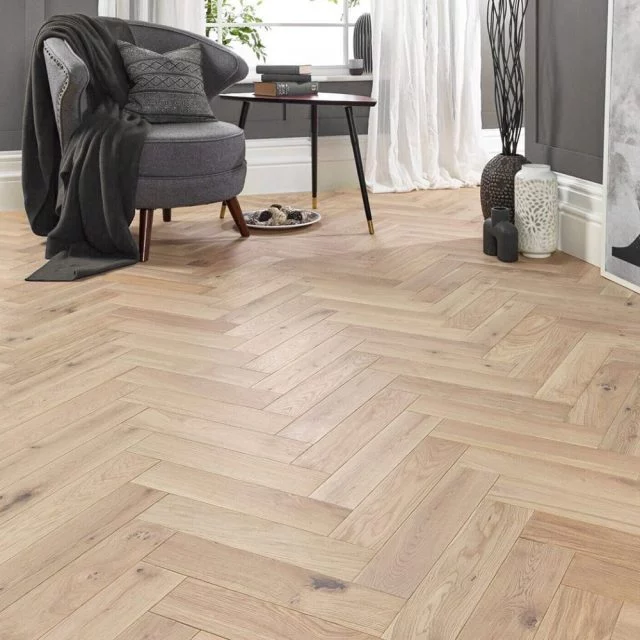
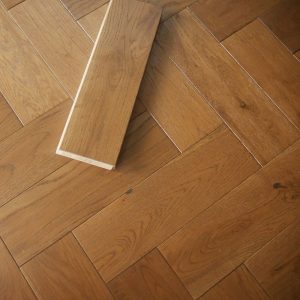
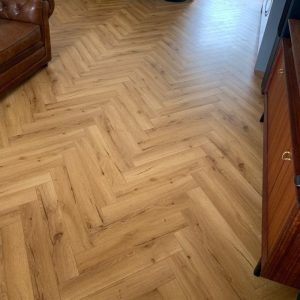
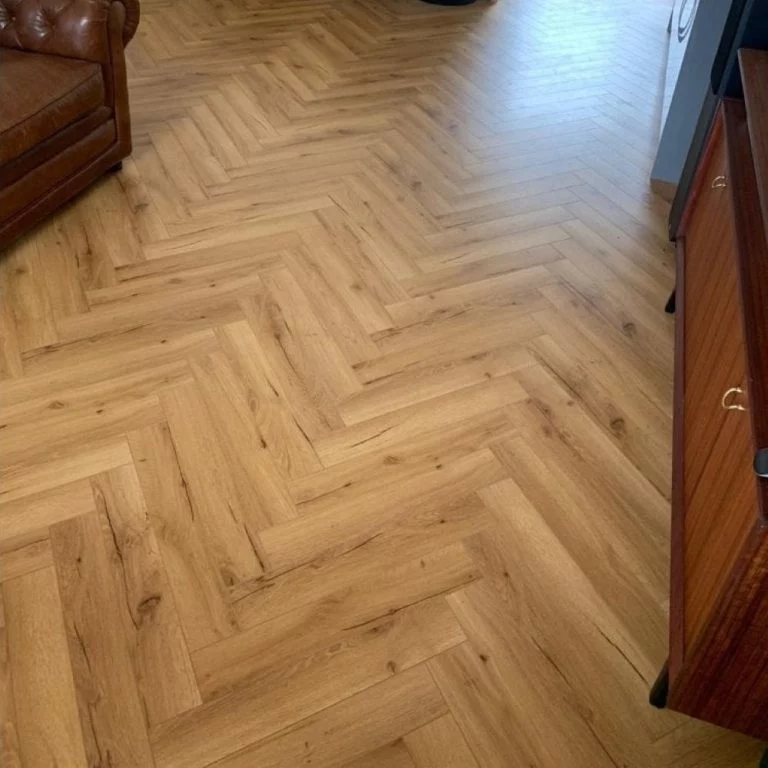
Herringbone is the same oak as a straight plank floor, arranged so that every block meets its neighbour at a right angle. That arrangement is the whole appeal and the whole difficulty. On a plank floor a small error disappears into the next row. In a herringbone field it accumulates, and by the far wall it is visible from the doorway.
Blocks arrive as left hand and right hand boards in matched quantities. Check both are present before you start, because a field laid with the wrong ratio cannot be finished.

The blocks in our range
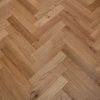
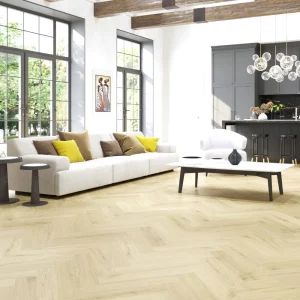
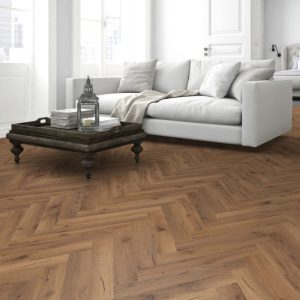
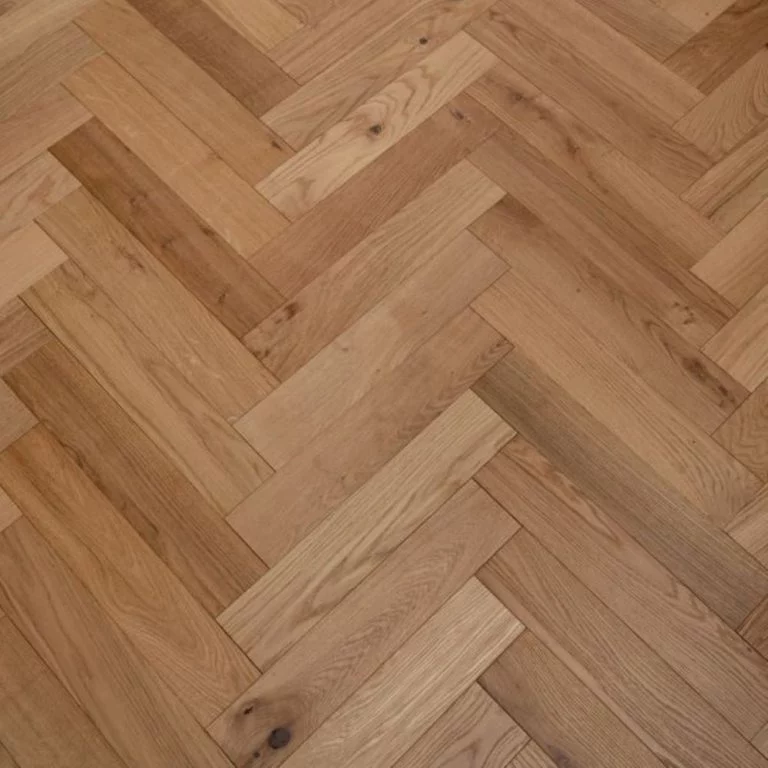
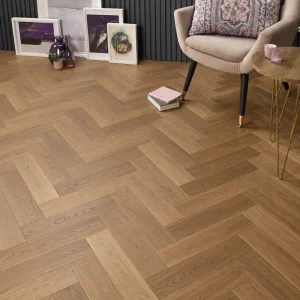
We sell 22 engineered herringbone floors, 20 in oak and 2 in American black walnut, in five block sizes. The Oxford blocks come at 14 × 90 × 450 mm, 14 × 125 × 600 mm and 18 × 80 × 300 mm, the Amersham blocks at 15 × 90 × 400 mm and the Cambridge blocks at 18 × 100 × 500 mm. All 22 are tongue and groove, and all are listed as compatible with underfloor heating.
For the same pattern as a click floor there are 13 more: 8 rigid vinyl and 5 laminate herringbone floors, which lock together and float over an underlay rather than being glued.
Order the right quantity
This is the number people get wrong, and it is the one that stops a job halfway.
Why glue down, and only glue down
A floating herringbone floor is a bad idea, and it fails in a predictable way. Each block is small, so each one carries very little of its neighbours. Without a bond to the subfloor the individual blocks work loose over time and the pattern opens at the joints.
Full glue down locks every block in position, keeps the pattern tight, and gives the firmer, quieter feel underfoot that people expect from parquet. It is also the method that works best over underfloor heating, because the floor is in direct contact with the heated slab rather than floating above an insulating air gap.
The published guidance says the same. The Contract Flooring Association describes solid wood block flooring as usually glued to the subfloor using bitumen or polymer adhesives. Ted Todd, a UK maker of wood floors, does not recommend floating installation for herringbone, because it can be difficult to avoid gaps between elements if the pattern runs out. Over underfloor heating, BEAMA, the UK underfloor heating trade association, says parquet blocks should be continuously glued onto the screed or timber deck for good heat transfer, with a floor temperature sensor fitted.
Setting out the pattern
The floor is decided by the first two rows. Everything after that follows them, including the mistakes.
The Contract Flooring Association sets out wood blocks this way: the first two lines of blocks should be laid on either side of an approximate centre line and should then continue outwards until a space is left for a border of longitudinally placed blocks plus an expansion gap. Ted Todd makes the centre line the starting point for its own herringbone floors, with the floor installed down this line and then working out to the perimeter.
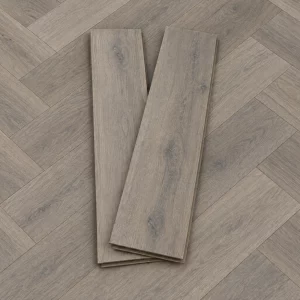
The blocks themselves come in two hands. The CFA notes that they are often manufactured in left hand and right handed versions to allow them to interlock properly in herringbone and similar patterns, so each row alternates the two. Count both hands before the first row goes down.
Before the room goes back into use
Adhesive needs time, and this is where an otherwise good job gets damaged.
What the published guidance says
Each entry is quoted from its source and linked to it. The full set is in the standards reference.
Wood blocks in herringbone: glued, handed, set out from the centre
The Contract Flooring Association says solid wood blocks are usually glued to the subfloor with bitumen or polymer adhesives, are often made in left-hand and right-hand versions so that they interlock in herringbone and similar patterns, and are set out with the first two lines laid either side of an approximate centre line, working outwards to a border of longitudinally placed blocks plus an expansion gap.
The exact wording
“Solid wood block flooring may be laid over any sound, dry, level subfloor and is usually glued to the subfloor using bitumen or polymer adhesives. … They will often be manufactured in left hand and right-handed versions to allow them to interlock properly when laid in herringbone and similar patterns. … The first two lines of blocks should be laid on either side of an approximate centre line and should then continue outwards until a space is left for a border of longitudinally placed blocks plus an expansion gap.”
Herringbone: from the centre line, not floated
Ted Todd, a UK maker of wood floors, sets out its herringbone floors from the centre line of the space, laying down that line and working out to the perimeter, and does not recommend floating installation for herringbone because gaps between the elements are hard to avoid if the pattern runs out.
The exact wording
“We do not recommend floating installation for Herringbone as it can be difficult to avoid gaps between elements if the patterns run-out. … The standard approach is for the centre line in the space to be the starting point, with the floor installed down this line and then working out to the perimeter.”
Herringbone and chevron — what the two patterns are
Herringbone is laid from rectangular blocks whose ends are cut square: set at right angles to each other and staggered, so that the end of one block meets the side of the next and the pattern reads as a broken zigzag. Chevron blocks have their ends cut at an angle - typically 45 or 60 degrees, depending on the manufacturer - so the ends meet on a continuous line and form a V. No published standard we could read defines the two patterns; the definitions here come from manufacturers and agree with each other.
The exact wording
“Herringbone flooring features rectangular wood planks arranged in a staggered zigzag pattern. Each plank meets the next at a 90-degree angle. In chevron patterns, the wood planks are cut at an angle, typically 45 or 60 degrees, so they meet in a continuous V-shape.”
Cutting waste — how much extra to order
There is no published industry standard for cutting waste; the figures come from manufacturers' own guidance and they vary. Havwoods advises 8-12 % wastage for planks and 15-20 % for patterned floors such as herringbone or chevron. Quick-Step's UK guidance for laminate is 5 % extra in a regular room and 10 % in a room with many angles or curves.
The exact wording
“For planks we typically advise on 8-12% wastage and patterned floors, such as herringbone or chevron, may need 15-20% wastage.”
Parquet over underfloor heating: glued down, with a floor sensor
BEAMA describes parquet as suitable for underfloor heating, with the blocks continuously glued onto the screed or timber deck for good heat transfer and a floor temperature sensor always fitted.
The exact wording
“Parquet – Also suitable for use with underfloor heating, these floor blocks should be continuously glued onto the screed or timber deck for good heat transfer. A floor temperature sensor should always be fitted.”
Acclimatisation before fitting
The Contract Flooring Association's guide asks for a steady room temperature of 18 to 27 °C, reached 48 hours before installation, so that the flooring can be kept in the room and reach room temperature before it is laid.
The exact wording
“They also advise that this temperature should be attained 48 hours prior to the installation, so that floorings can be kept in the room and brought to room temperature (acclimatised) before installation.”
CFA guidance — the subfloor is the installer’s first responsibility
The CFA Guide to Contract Flooring requires the base to be a clean, sound, level surface that is strong enough to carry the preparation materials and the floor finish, mechanically prepared and dust free, and dry enough to give a hygrometer reading of no more than 75% relative humidity.
The exact wording
“Before the application of the floor finish a solid (cementitious or similar) base must be sufficiently dry to show a hygrometer reading not greater than 75% Relative Humidity when tested in accordance with the British Standard Code of Practice.”
Questions about fitting herringbone
Can herringbone be floated rather than glued?
How much waste does a herringbone floor produce?
Where should the pattern start?
Do herringbone blocks come in left and right hand versions?
Is there a click herringbone floor?
Does herringbone work over underfloor heating?
- Samples £1.99 each
- UK-wide delivery
- Advice before you order