
Samples available UK-wide delivery

Your Cart

0

Your cart is empty

Start with a sample: real cuts of our floors at £1.99 each, sent to your door across the UK.

Subtotal £0.00
Shipping & discounts calculated at checkout
SSL encrypted, safe and secure
Best Flooring for Bathrooms
Room guide 8 min read

Best Flooring for Bathrooms

Bathrooms are where the wrong floor fails quickly: what copes with standing water and steam, how each of our floors is fitted, and where wood fits in.

Start reading
On this page
  1. Why bathrooms are different
  2. What works
  3. Fitting matters more here
  4. Wet floors and slipping
  5. The walls as well
  6. Keeping it right
  7. What the published guidance says
  8. Read next
  9. Questions about bathroom floors
01

Why bathrooms are different

Every other room gets the occasional spill. A bathroom gets water on the floor as part of normal use, every day, plus steam that raises the humidity of the whole room for an hour at a time.

Timber responds to that humidity by taking up moisture and swelling. In a room where that happens daily, the movement never settles into the calm seasonal rhythm a wood floor lives by elsewhere in the house.

Good to know: It is rarely the puddle that damages a bathroom floor. It is the water that runs into a joint and stays there.
02

What works

Two clear answers and one honest compromise.
Rigid vinyl (LVT)
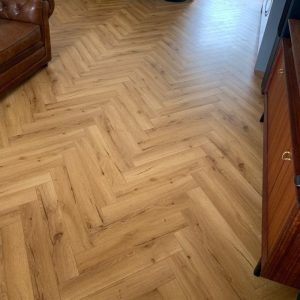
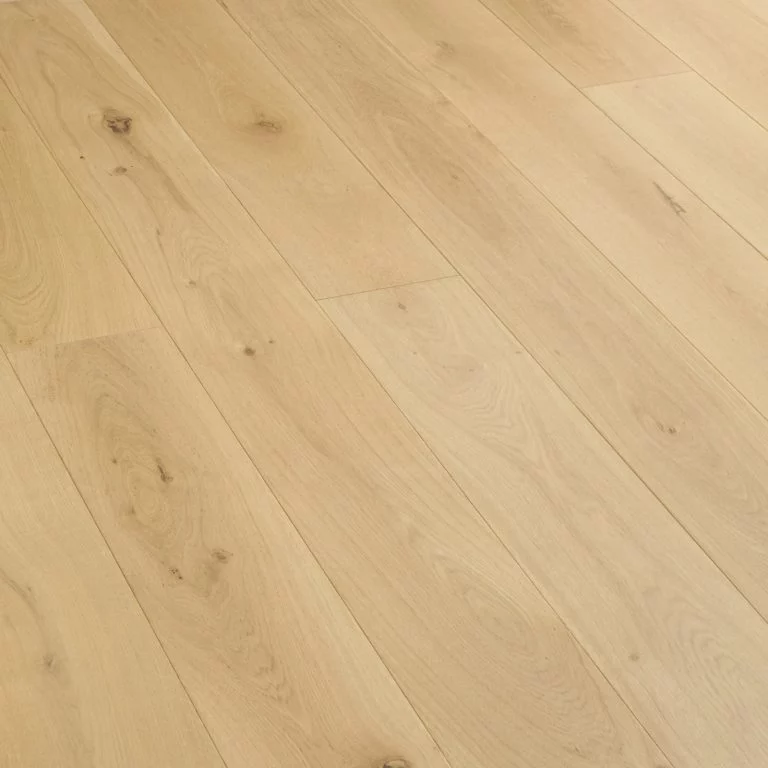
All 36 floors in our range are listed as waterproof and compatible with underfloor heating, in wood and stone looks. They click together and float, and the edges are sealed to the fitting instructions.
Porcelain tiles
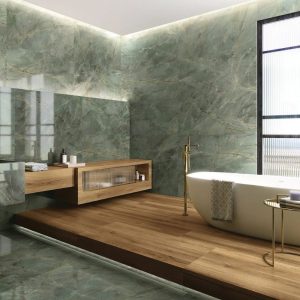
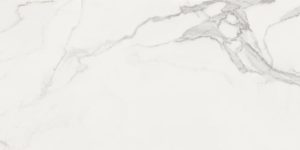
The most permanent floor. 11 in our range, all 600 × 1200 mm and listed for underfloor heating. In a bathroom choose a matt or textured finish over a polished one and ask for a barefoot figure: a wet pendulum value with the Slider 55 rubber, or DIN 51097 class B or C. The R11 of the 2 Wabi lappato tiles is a test with shoes and oil.
Engineered wood
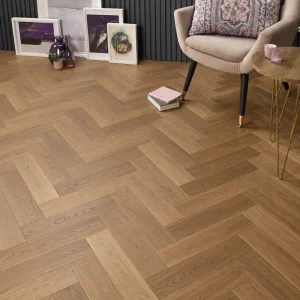
Possible in a well ventilated cloakroom with no bath or shower. Not in a family bathroom: the NWFA says standing water will result in cracks, splits, cupping and warping of a wood floor.
Solid wood and laminate
Avoid. Solid oak moves more with moisture than engineered, and laminate has a wood fibre core that swells once water reaches it.
See also
03

Fitting matters more here

The material is only half the answer. In a bathroom the detail around it decides whether it lasts.

1
Fit each floor its own way
Our rigid vinyl clicks together and floats: the MMFA says floors of this kind should only be laid as a floating installation, with an expansion gap at the edges. Tiles are bonded to the base.
2
Mind the perimeter
The edges around the bath, the shower tray and the WC are where water gets underneath. A tiled floor is sealed there with silicone; a floating rigid vinyl floor keeps its expansion gap free of silicone, as the MMFA requires, and is finished with the trims its maker specifies.
3
Get the subfloor level first
Water finds the low point. A hollow under a bathroom floor collects it and holds it.
4
Plan for ventilation
An extractor that actually runs does more for a bathroom floor than any coating.
Important: Fitting any floor over a subfloor that failed a moisture test is a mistake everywhere. In a bathroom it is a fast one.
04

Wet floors and slipping

A bathroom floor is walked on wet and barefoot. The HSE grades slip potential by the pendulum test value: 0 to 24 is high, 25 to 35 moderate and 36 or more low. Ask for the figure measured wet.

Of our 11 porcelain tiles, 5 are polished, 4 lappato and 2 matt, and the 2 Wabi lappato tiles carry an R11 rating, which is measured with shoes and oil, not barefoot. 32 of our 36 rigid vinyl floors have a textured surface. The slip resistance guide explains what each rating does and does not tell you.

05

The walls as well

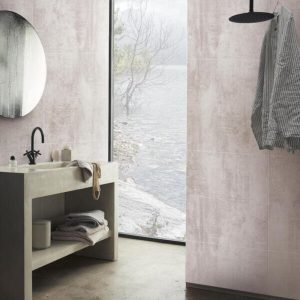
Grout on a shower wall is the other half of bathroom maintenance. Our 5 Wall and Water shower panels are 10.2 mm thick and fit with an interlocking system, so a bathroom can be finished without tiling the walls.

See also
06

Keeping it right

Simple, and mostly about not letting water stand.

Wipe rather than wait
Standing water is the whole problem. A towel by the bath solves most of it.
Run the extractor longer
Well past the end of the shower. The humidity is what lingers.
Check the seals yearly
Silicone shrinks and cracks. That is how water gets under a floor that was fitted correctly.
Bath mats, not rugs
Something you can lift and dry, rather than something that holds damp against the floor.
07

What the published guidance says

Published standards

Each entry is quoted from its source and linked to it. The full set is in the standards reference.

1 of 8
Health and Safety Executive

Pendulum Test Value — how slip risk is assessed

36 + PTV low slip potential
25-35 PTV moderate slip potential
0-24 PTV high slip potential

HSE grades pedestrian slip potential from the pendulum test value (PTV): 0-24 is high slip potential, 25-35 moderate and 36 or above low slip potential, the pendulum coefficient-of-friction test being the subject of BS 7976 Parts 1-3.

The exact wording

“Table 1 Slip potential classification, based on pendulum test values (PTV) PTV High slip potential 0-24 Moderate slip potential 25-35 Low slip potential 36 +”

Source: HSE - Assessing the slip resistance of flooring (GEIS2)
Multilayer Modular Flooring Association

Cleaning — the manufacturers’ own guidance

For multilayer modular floor coverings the MMFA requires low-moisture cleaning methods and states that pooling of liquid on the floor must be avoided under all circumstances.

The exact wording

“Absolutely avoid ponding in any case!”

Source: Basic cleaning — MMFA (Multilayer Modular Flooring Association)
Multilayer Modular Flooring Association

Multilayer modular floors: floating, with a gap per metre

1.5 mm Expansion gap per running metre of floor, each side (rule of thumb)

The MMFA, the European association for multilayer modular floor coverings, says these floors expand and contract with temperature and humidity and should therefore only be laid as a floating installation, with an expansion gap of at least 1.5 mm per running metre of floor on each side of the room as a rule of thumb.

The exact wording

“As MMF floor coverings expand and contract due to changes in ambient temperature or humidity conditions, the flooring should only be laid as a floating installation. … As a rule of thumb: create an expansion gap of min. 1.5 mm per running meter of flooring on each side of the room (e.g. room width 5 m = 8 mm border joint on each side).”

Source: TB 2 - MMFA Technical bulletin 12/2023 - Installation of Multilayer Modular Floor Coverings (English Edition 12/2023), Multilayer Modular Flooring Association
Uponor

Maximum floor surface temperature

29 °C occupied area
35 °C edge zone
33 °C bathrooms

EN 1264 caps the floor surface temperature at 29 °C in the occupied area, 35 °C in the edge (perimeter) zone and 33 °C in bathrooms.

The exact wording

“Max. surface temperatures in DIN EN 1264: • 29 °C in the occupied area • 35 °C in the edge zone • 33 °C in bathrooms”

Source: Uponor underfloor heating/cooling — Planning information (Technical Information TI-1186660)
BEAMA

Vinyl over underfloor heating: 26 °C

26 °C maximum temperature for most vinyls

BEAMA advises that most vinyls should not be heated above 26 °C, so the floor temperature should be restricted, and warns that in rooms with high heat losses such as conservatories a restricted floor temperature may not heat the room sufficiently.

The exact wording

“However, as most vinyls should not be heated to above 26°C, the floor temperature should be restricted. Care should be taken in the design of systems in rooms with high heat losses, such as conservatories, as it may not be possible to sufficiently heat the room with a restricted floor temperature limit.”

Source: BEAMA Underfloor Heating — Choosing your floor covering to maximise your underfloor heating efficiency (April 2020)
BEAMA

Tiles over underfloor heating: decoupling membrane and flexible adhesive

With stone, slate and ceramic tiles over underfloor heating, BEAMA advises always using a decoupling membrane and flexible adhesive to reduce the risk of hairline expansion cracks.

The exact wording

“With stone (which includes slate) and ceramic tiles, it is always advisable to use a de-coupling membrane and flexible adhesive to reduce the potential for any hairline expansion cracks.”

Source: BEAMA Underfloor Heating — Choosing your floor covering to maximise your underfloor heating efficiency (April 2020)
USDA Forest Products Laboratory

Wood takes on moisture from the air

The Wood Handbook of the US Forest Products Laboratory says wood, like many natural materials, is hygroscopic: it takes on moisture from the surrounding environment, and the exchange of moisture between wood and air depends on the relative humidity and temperature of the air and on the water already in the wood.

The exact wording

“Wood, like many natural materials, is hygroscopic; it takes on moisture from the surrounding environment. Moisture exchange between wood and air depends on the relative humidity and temperature of the air and the current amount of water in the wood.”

Source: Wood Handbook — Wood as an Engineering Material, General Technical Report FPL-GTR-282 (2021), chapter 4 "Moisture Relations and Physical Properties of Wood", page 4–1 — USDA Forest Service, Forest Products Laboratory
National Wood Flooring Association

Standing water and a wood floor

The US National Wood Flooring Association warns against cleaning a wood floor with a traditional mop and bucket that can apply too much moisture, because standing water results in cracks, splits, cupping, warping and degradation of the finish.

The exact wording

“Do not use a traditional mop and bucket that has a potential to apply too much moisture to the wood floor. Standing water will result in cracks, splits, cupping, warping, degradation of the finish, and can leave a discoloring and sometimes sticky residue.”
Source: NWFA Wood Flooring Installation Guidelines, Revised 2025 - National Wood Flooring Association (maintenance chapter)
See also
08

Read next

09

Questions about bathroom floors

Can I put wood flooring in a bathroom?
We do not recommend it. Standing water and daily steam cause timber to take up moisture and swell, and the joints are where it gets in. For the look of wood, a wood effect rigid vinyl listed as waterproof gives the warmth without the movement; the edges are sealed to the fitting instructions.
Is LVT or tile better for a bathroom?
Both work. Porcelain is the more permanent floor and the one that lasts the life of the bathroom; rigid vinyl is warmer, quieter, lighter on a first floor on joists, and can be lifted when the bathroom is refitted. The wall panels avoid grout on the walls either way.
Is rigid vinyl waterproof enough for a bathroom?
All 36 rigid vinyl floors in our range are listed as waterproof: the plank does not take up water. The edges, the joints and the base below are where water gets in, so they are sealed to the fitting instructions, and the MMFA says to avoid ponding in any case.
What matters more, the floor or the sealing?
The sealing. Water gets under a bathroom floor at the edges: the bath, the shower tray and the door threshold. A floor listed as waterproof does not make the room waterproof; the edges sealed to the fitting instructions do.
Can I have underfloor heating in a bathroom?
Yes, and it suits a tiled floor well. EN 1264 allows a slightly higher surface temperature in bathrooms, 33 °C, than in living areas, 29 °C. Rigid vinyl sets its own lower limit: BEAMA notes that most vinyls should not be heated to above 26 °C. Every porcelain tile and every rigid vinyl plank in our range is listed for underfloor heating.
Your next step
Find a waterproof floor you actually like
LVT now comes in convincing wood and stone finishes. Order a sample and check it in the light your bathroom actually has.
  • Samples £1.99 each
  • UK-wide delivery
  • Advice before you order
Not sure it suits your room?
A real cut from a real board. Samples £1.99 each, up to 10 per order.
Order samples · £1.99

Join the Homes & Floors Club

New ranges and offers. Hear it first.

  • Room ideas & honest guides
  • New floors first
  • Special offers

No spam. Unsubscribe any time.