











Best Flooring for Underfloor Heating: What Works and What to Avoid
Construction decides this, not appearance. Which floors in the range are listed for underfloor heating, the temperature and thermal resistance limits the standards set, and the commissioning sequence that prevents most of the problems.
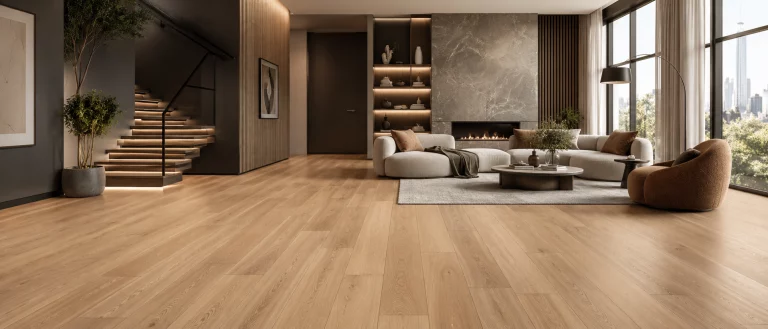
Engineered wood
33 of 33 listed
Solid wood
Not listed (0 of 15)
Surface limit, EN 1264
29 °C in the room
Floor covering limit
0.15 m²K/W
1/ 7
01
What works and what does not
Two floors can look identical and only one can go over a heated screed. It is decided by how the board is built, and it shows in the listings of our own range on the catalogue of 15 September 2026: every engineered board, every laminate, every rigid vinyl plank and every porcelain tile is listed as compatible with underfloor heating, and none of the fifteen solid oak boards is.
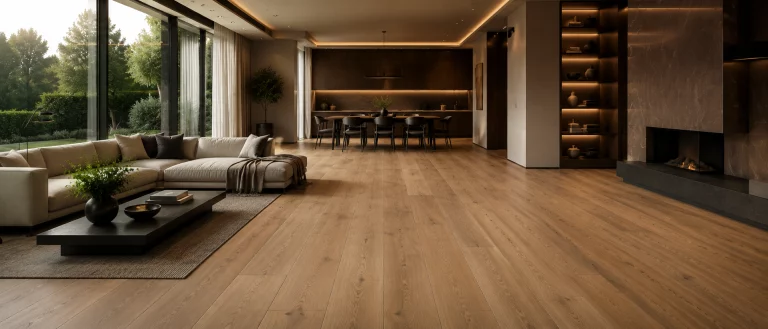
Engineered wood
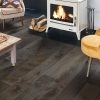
Listed, 33 of 33. The cross layered core keeps the board dimensionally stable through the heating cycle.
Rigid vinyl (SPC)
Listed, 36 of 36. A thin, dense board that conducts heat well; floated on an underlay rated for heating.
Laminate
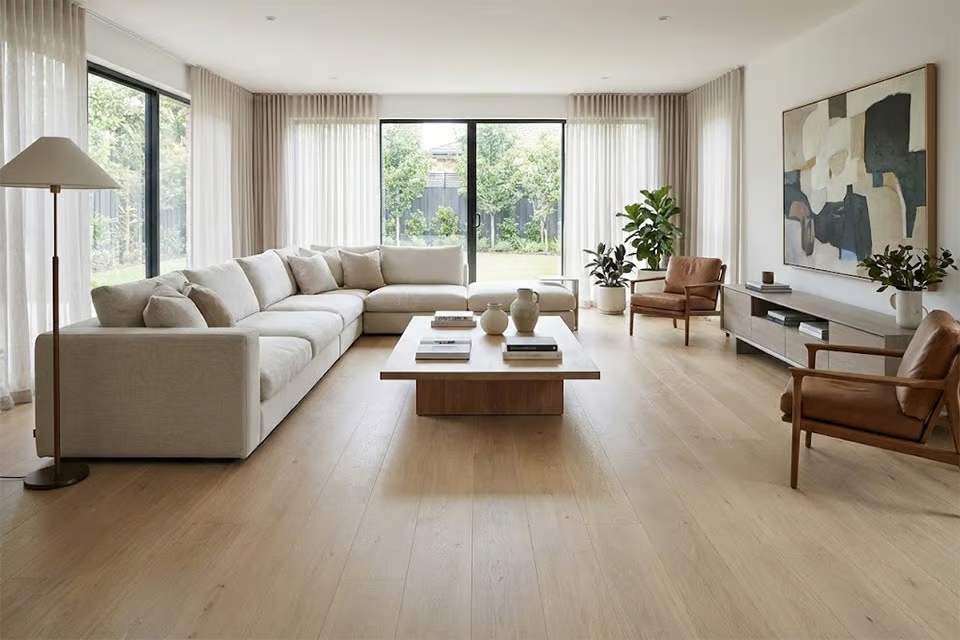
Listed, 12 of 12, on the same condition: an underlay rated for heating, as thin as the product allows.
Porcelain tiles
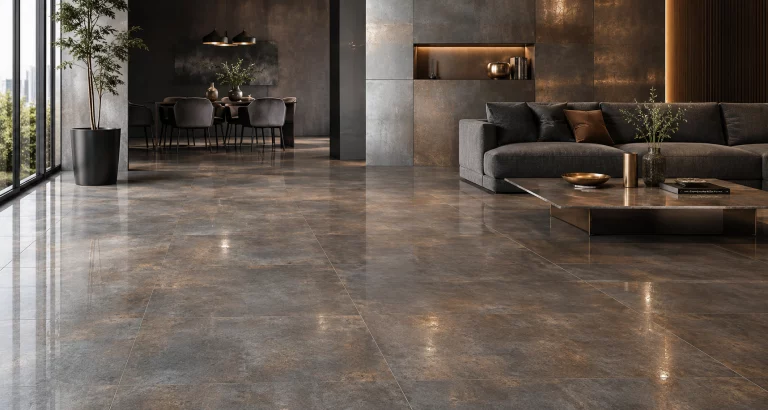
Listed, 11 of 11, and the material that passes heat through most readily of the four.
Parquet blocks
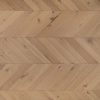
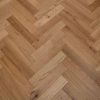
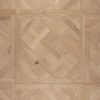
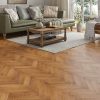
Listed, 15 of 15: the Oxford herringbone, the Knightsbridge chevron and the Versailles panels. Glued down, which suits a heated screed.
Solid wood
Not listed, 0 of 15. A single piece of timber moves too much across the cycle and no fitting method compensates for it.
The most common mistake: Falling for a solid oak floor and then discovering the room has underfloor heating. Settle this before you choose a finish, not after.
Two numbers govern a floor over water based underfloor heating, and both come from the published standards rather than from any supplier. The first is the surface temperature: EN 1264, the standard for water based surface embedded heating, caps the floor surface at 29 °C in the occupied area of a room, 33 °C in a bathroom and 35 °C in the perimeter zone. The Contract Flooring Association adds that some hardwood finishes are installed with a lower limit of 27 °C, which is why the fitting instructions of the product govern where they state a figure.
The second is thermal resistance. Everything between the screed and the room slows the heat down, and the systems are designed around a total floor covering resistance of no more than 0.15 m²K/W. Underlay figures are often given in tog; one tog is 0.1 m²K/W, so a 1.5 tog underlay on its own uses the whole allowance before the floor goes on top of it. That is why a thick acoustic underlay chosen for comfort can undo a good heating system.
Surface temperature, occupied area
29 °C (EN 1264)
Surface temperature, bathrooms
33 °C (EN 1264)
Some hardwood finishes
27 °C (CFA guidance)
Floor covering thermal resistance
no more than 0.15 m²K/W; 1 tog = 0.1 m²K/W
Important: Stay within the surface temperature your heating manufacturer specifies and keep the floor plus underlay within the resistance the system was designed for. Exceeding either is the fastest way to damage a wood floor and it is not covered by any guarantee.
03
Method matters more here
Heat has to travel from the screed into the room. Glue down puts the board in direct contact with the heated surface and performs best; a floating floor sits over an underlay, which is an insulating layer by design, so the underlay has to be one rated for underfloor heating and as thin as the product allows.
Preferred
Glue down, for engineered wood and for rigid vinyl where the product allows it
If floating
An underlay rated for underfloor heating, thermal resistance stated on its datasheet, kept within the 0.15 m²K/W total
Pattern floors
Herringbone and chevron blocks are glued down anyway, which suits underfloor heating well
Tiles
Bedded in a flexible adhesive rated for heated screeds, with movement joints where the tile manufacturer asks for them
04
The sequence that prevents problems
This order is not optional, and getting it wrong is where most underfloor heating failures begin. The Contract Flooring Association's guidance puts the commissioning cycle at about 21 days; the screed itself dries at roughly a day per millimetre for the first 50 mm under BS 8204, so a new floor is weeks away from the day the screed is poured.
1
Let the screed dry first
One day per millimetre for the first 50 mm is the BS 8204 rule of thumb; a hygrometer reading, not the calendar, says when it is dry.
2
Run the system through its full cycle
Heating up and cooling down over about three weeks before any floor covers it. This drives out construction moisture that would otherwise be trapped.
3
Test moisture after commissioning
The reading that counts is the one taken after the heating cycle, with the system off and the screed cool.
4
Fit onto a cool floor
Boards laid onto a warm surface will move as it cools.
5
Raise the heat in small steps
Over several days rather than in one go. It is the sudden change that damages timber, not the heat.
6
Come down slowly in spring
Turning the system off in one step is the same shock in the other direction.
05
Living with a heated floor
A heated room is a drier room, and wood responds to that.
Watch the humidity
Heating season dries the air. Joints open slightly in winter and close again in summer; that is normal in a real wood floor and not a fault.
Do not trap the heat
Large rugs and floor standing furniture create a hot spot the thermostat never sees, and a hot spot is where the surface limit is exceeded first.
Keep the same care routine
Damp mop only, felt under furniture, mats at the doors.
Keep the paperwork
The commissioning record and the underlay datasheet are what a warranty question about a heated floor will ask for.
06
What the published standards say
Published standards
Each entry is quoted from its source and linked to it. The full set is in the standards reference.
Maximum floor surface temperature
EN 1264 caps the floor surface temperature at 29 °C in the occupied area, 35 °C in the edge (perimeter) zone and 33 °C in bathrooms.
occupied area
29 °C
edge zone
35 °C
bathrooms
33 °C
“Max. surface temperatures in DIN EN 1264:
• 29 °C in the occupied area
• 35 °C in the edge zone
• 33 °C in bathrooms”
Floor coverings over a warm water underfloor heating system are normally limited to a thermal resistance of R(λ,B) ≤ 0.15 m2K/W, which is also the worst permissible case used for system dimensioning in dwellings.
maximum thermal resistance of floor covering (R lambda,B)
0.15 m2K/W
“The following types of floor coverings can be laid on Uponor surface heating/cooling systems if a maximum thermal resistivity of Rλ,B ≤ 0,15 m²K/W is observed and approved by the manufacturer”
Commissioning the heating before the floor goes down
Before any subfloor preparation or floorcovering is laid, the underfloor heating must be run through a full drying and commissioning cycle of heating up and cooling down, typically lasting about 21 days.
typical duration of the heat-up / cool-down commissioning cycle
21 days
“In all instances, UFH systems must be run through a full drying / commissioning cycle of heating up and cooling down before any subfloor preparation or installation of decorative floor coverings are installed. This period of commissioning is usually around 21 days.”
UK trade-association guidance sets no blanket ban on wood over underfloor heating but ties it to a temperature limit, noting that some hardwood floor finishes are installed with a maximum floor surface temperature of 27 °C.
maximum floor surface temperature for some hardwood finishes
27 °C
“For example, some hardwood floor finishes are installed with a maximum floor surface temperature of 27°C.”
BS 8204-1 gives a drying allowance of one day per millimetre of thickness for the first 50 mm of a levelling screed, with longer per-millimetre times above that thickness, so a 50 mm screed drying in good conditions takes roughly two months.
drying allowance, first 50 mm
1 day per mm
thickness covered by the 1 day/mm rule
50 mm
resulting drying time for a 50 mm screed, good conditions
about 2 months
“with levelling screeds, one day should be allowed for each millimetre of thickness for the first 50 mm, followed by an increasing time for each millimetre above this thickness. It is therefore reasonable to expect a levelling screed 50 mm thick, drying under good conditions, to be sufficiently dry in about 2 months.”
BS EN 1264 covers water based surface embedded heating and cooling systems in five parts: definitions and symbols (Part 1), determination of the thermal output (Part 2), dimensioning (Part 3), installation (Part 4), and determination of the thermal output for surfaces embedded in floors, ceilings and walls (Part 5).
Part 1
Definitions and symbols
Part 2
Determination of the thermal output
Part 3
Dimensioning
Part 4
Installation
Part 5
Heating and cooling surfaces embedded in floors, ceilings and walls. Determination of the thermal output
“Part 1 Floor heating. Systems and components. Definitions and symbols
Part 2 Floor heating. Systems and components. Determination of the thermal output
Part 3 Floor heating. Systems and components. Dimensioning
Part 4 Floor heating. Systems and components. Installation
Part 5 Water based surface embedded heating and cooling systems. Heating and cooling surfaces embedded in floors, ceilings and walls. Determination of the thermal output”
Not from our range: none of the fifteen solid oak boards is listed for it, because a single piece of timber moves too much across the heating cycle. The engineered boards give the same oak surface on a core built for a heated screed, and all 33 are listed.
Which floor conducts the heat best?
Porcelain tile passes heat through most readily, then rigid vinyl, then engineered wood and laminate floated on a thin heating rated underlay. What matters more than the material is the total thermal resistance of floor plus underlay, which the systems are designed to keep at or below 0.15 m²K/W.
What temperature can the floor surface reach?
EN 1264 caps it at 29 °C in the occupied area of a room, 33 °C in bathrooms and 35 °C in the perimeter zone. Some hardwood finishes are installed with a 27 °C limit on the Contract Flooring Association's guidance, and the product's fitting instructions govern where they state a figure.
How long after the screed is poured can the floor go down?
Weeks. BS 8204 allows a day per millimetre for the first 50 mm of screed, and the heating then runs through a commissioning cycle of about 21 days before any covering is laid. A hygrometer reading taken after that cycle, with the screed cool, is what says the floor is ready.
Do I need a special underlay?
For a floating floor, yes: one rated for underfloor heating with its thermal resistance stated, chosen so that floor plus underlay stay within 0.15 m²K/W. Underlay figures given in tog are divided by ten to get m²K/W.
Choosing a floor for a heated room?
Engineered wood, rigid vinyl, laminate and porcelain in our range are all listed for underfloor heating. Order samples of two and decide with the material in front of you.
We use essential cookies to run the shop: your basket, checkout, account and site security. Optional cookies are only set if you allow them, and you can change your choice at any time under “Cookie Preferences” at the foot of every page. Details are in our Cookie Policy.
Essential
Basket, checkout, account login, payment security (Stripe) and protection against automated attacks (Cloudflare).
Always on
Analytics
Not in use at the moment. If we add a measurement tool, it will only run when this is switched on.
Marketing
Records which website, search or advert brought you to us, so we can see which campaigns lead to orders (WooCommerce order attribution). Deleted when you close your browser.