



Best Flooring for Conservatories and Garden Rooms
A conservatory swings further in temperature and light than any room in the house. What that does to a floor, and which constructions cope.
A conservatory is the hardest environment in a British house, and almost nobody specifies the floor for it. The room can sit at thirty degrees on an August afternoon and near freezing the same night in February, and it does that every year for as long as the floor is down.
Two things follow from that, and they decide the whole choice: movement, and sunlight.
Movement is the first problem
Every floor expands and contracts with temperature and humidity. In most rooms the swing is small enough that an expansion gap absorbs it. In a conservatory the swing is several times larger, and a floor specified as if for a living room will show it — as gapping between boards in winter, or as a floor that lifts at the perimeter in summer.
Solid timber is the wrong answer here. Not marginally — it is the construction least able to cope with a large, repeated swing, and a conservatory delivers exactly that.
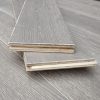
Engineered wood can work, because the cross-bonded core is what restrains movement. It needs a generous expansion gap all round, proper acclimatisation, and honesty about the temperatures the room actually reaches.
Rigid-core vinyl is the specification most likely to survive without argument. A dense mineral core is dimensionally stable across a wide temperature range, it takes on no water from condensation, and it does not mind a subfloor that is less than perfect. Check the manufacturer's stated temperature range rather than assuming; ranges differ, and this is the room where the difference shows.
Porcelain tile has effectively no issue with either heat or water and is the traditional conservatory floor for good reason. It is cold underfoot in winter, which is the trade — and the one case where underfloor heating changes the room rather than just warming it.
Common questions
Can I lay wood flooring in a conservatory?
Engineered wood, yes, with care — a generous expansion gap, full acclimatisation in the room itself, and a realistic view of the temperatures it will see. Solid timber is the one to avoid: it has nothing restraining its movement, and a conservatory asks it to move further and more often than any other room in the house.
Will the sun fade my floor?
Some change is normal in any room with direct sun, and a conservatory gets the most of it. What causes complaints is not the fading itself but that it is uneven, because a rug or a sofa shields part of the floor. Ask about UV stability before you buy, favour a mid tone, and move the furniture occasionally in the first couple of years.
Does the floor need to match the room next door?
It rarely has to, and often should not. A conservatory is a different environment, and specifying it as a continuation of the living room is how the wrong floor gets chosen. If a visual run-through matters, match the tone rather than the product — a rigid-core floor in the same shade as the timber next door reads as continuous and behaves as the room requires.
The construction question is the same one that decides underfloor heating, and it is set out in what works over underfloor heating. For the rigid-core option, what SPC actually is explains why the core matters more than the surface.
How hot a conservatory gets, and how often it freezes, depends on where the house is. Browse our coverage by town and region.
The rigid-core floors this guide keeps coming back to are in the LVT range.