















Samples available UK-wide delivery

Your Basket

0

Your basket is empty

Browse our editorial collections and find your perfect floor.

Browse Collections
Subtotal £0.00
Shipping & discounts calculated at checkout
SSL encrypted — safe and secure
Technical guide 3 min read

Moisture, Humidity and Room Climate

Wood moves with the air around it. What that means in a British home, what is normal and what is not, the readings the standards ask for before a floor goes down, and how to keep a room stable through the year.

Applies to
All wood and laminate floors
Subfloor, resilient floors
75% RH or below (BS 8203 practice)
Subfloor, solid timber
65% RH or below
Acclimatisation
48 hours minimum
1/ 7
01

Why wood moves at all

Timber is hygroscopic. It takes moisture out of the air when the air is damp and gives it back when the air is dry, and it changes size as it does so. This never stops. A wood floor is not a static object and was never sold as one.

In a British home the swing is predictable. Winter heating dries the air, boards give up moisture and shrink slightly, so fine gaps can appear at the joints. Summer brings the moisture back, the boards take it up and the gaps close. A floor that behaves this way is behaving correctly, and it is not a sign that anything was fitted badly.

When to worry: Cupping, lifting, or a gap that never closes are different. Each has a cause worth finding, and it is usually moisture from below rather than humidity above.
02

Construction decides how much it moves

Two floors can look identical and behave completely differently, because what governs movement is how the board is built.

Solid wood
One piece of timber. Moves the most across its width, which is why it is not listed for underfloor heating.
Engineered wood
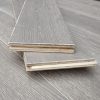
A real oak wear layer over a cross layered core. The layers restrain each other, so the board holds its width. EN 13489 requires the elements to leave the factory at 5% to 9% moisture content.
Laminate
An HDF core that also takes up moisture; it moves as one floating sheet, which is why the edge gap and the door thresholds matter.
Rigid vinyl
Not timber, so humidity does not affect it. It does respond to temperature, which is a different problem with a different answer.
See also
03

What to measure, and when

Two instruments answer almost every question here, and neither is expensive. The readings below are the ones UK practice works to.

Room humidity
A hygrometer on a shelf tells you what the floor is living in. Read it in January and again in July; two readings tell you more than any amount of guessing.
Subfloor moisture
A hygrometer sealed to the slab, left until it reaches equilibrium: 75% relative humidity or below for resilient and multilayer floors, 65% for solid timber, in BS 8203 practice. Test in several places, including near external walls, which are the coldest and often the dampest points.
A new screed
Dries at roughly a day per millimetre for the first 50 mm under BS 8204, so a 50 mm screed in good conditions takes about two months. The reading, not the calendar, says when it is dry.
After commissioning
Over underfloor heating, the reading that counts is the one taken after the system has been run through its cycle and cooled, not before.
Important: Where your product fitting instructions state a moisture figure, that figure governs. It differs by construction and by fitting method, and it is the number your guarantee is written against.
04

Keeping a room stable

You are not trying to hold the room at one number. You are trying to avoid violent changes.

1
Finish wet trades before fitting
Plaster, screed and paint all release water for weeks. A floor laid into that will move once the room dries out.
2
Let the packs settle in the room
Flat and unopened where they will be fitted, for at least 48 hours at the room's in service temperature, longer where the fitting instructions say so. The MMFA puts the storage range at 15 to 25 °C and 35% to 65% relative humidity.
3
Heat gradually in autumn
Bringing a system up in stages over several days gives the boards time to follow. It is the sudden change that damages timber.
4
Ventilate rather than dry aggressively
A dehumidifier run hard in one room creates exactly the swing you are trying to avoid.
5
Lower it gradually in spring
Turning underfloor heating off in one step is the same shock in the other direction.
05

The difficult rooms

Some rooms are harder than others, and it is worth knowing before you order rather than after.

Conservatories
The widest temperature and humidity range in the house. Rigid vinyl or porcelain suit it; where wood is wanted, glue down performs far better than floating.
New builds
Plaster and screed release water for months. Fitting too early is the most common cause of later movement.
Holiday homes
Long unheated periods followed by sudden heating. Keep a low background temperature instead.
Rooms with a lot of glass
Direct sun heats and dries a floor unevenly. Blinds during the brightest hours help more than they sound like they would.
Ground floors without a membrane
Approved Document C asks a floor next to the ground to resist moisture from below. An older slab may have no damp proof membrane; the hygrometer reading tells you, and the floor above it will not fix it.
06

What the published standards say

Published standards

Each entry is quoted from its source and linked to it. The full set is in the standards reference.

BS 8203 — relative humidity limit for a subfloor

UK practice following BS 8203 treats a subfloor as dry enough for resilient floor coverings when hygrometer readings do not exceed 75% relative humidity (65% RH for solid timber coverings), measured with a hygrometer sealed to the surface so that it reaches equilibrium with the base.

RH limit, resilient floor coverings75 % RH
RH limit, solid timber floor coverings65 % RH

“The base can be considered dry enough to install most floorcoverings if a series of tests produce readings not exceeding 75% R.H. (65% R.H. for solid timber floorcoverings).”

Source: F. Ball and Co. Ltd - Digital Hygrometer, Technical Data Sheet

Room conditions at the time of fitting

The MMFA, the European association for multilayer modular floor coverings, requires the flooring to acclimatise for at least 48 hours in the same conditions as the installation area, stored flat and cross-stacked in unopened boxes at roughly 15-25 degrees Celsius and 35 to 65 per cent relative humidity.

acclimatisation before installationat least 48 h
storage and acclimatisation temperature15-25 °C
storage and acclimatisation relative humidity35-65 %

“Leave the floor covering to acclimatise in the same environmental conditions as the installation area for a period of at least 48 hours prior to installation. Always store the boards flat and cross-stacked, in their original unopened boxes and at approx. 15-25 °C and between 35 % and maximum 65 % relative humidity.”

Source: Prior to installation — MMFA (Multilayer Modular Flooring Association)

Acclimatisation before fitting

The Contract Flooring Association's guide states that the room should be at its in-service temperature 48 hours before installation so that the flooring can be kept in the room and reach room temperature before it is laid.

conditioning before installation48 h

“They also advise that this temperature should be attained 48 hours prior to the installation, so that floorings can be kept in the room and brought to room temperature (acclimatised) before installation.”

Source: CFA Guide to Contract Flooring - Contract Flooring Association

Moisture content at delivery — what EN 13489 requires

EN 13489, the product standard for multi-layer parquet, requires the moisture content of the elements to be between 5 % and 9 % at the time of first delivery, measured by the oven-dry method of EN 13183-1. The corresponding figure for solid parquet under EN 13226 was not available from a source we could read, so it is not stated here.

Moisture content at first delivery, multi-layer parquet (EN 13489:2023, clause 4.1.2)5-9 %

“The moisture content shall be between 5 % and 9 % at the time of the first delivery of the product.”

Source: EN 13489:2023 - Wood-flooring and parquet - Multi-layer parquet elements (SIST preview of the standard, clause 4.1.2 Moisture content)

How long a screed takes to dry

BS 8204-1 gives a drying allowance of one day per millimetre of thickness for the first 50 mm of a levelling screed, with longer per-millimetre times above that thickness, so a 50 mm screed drying in good conditions takes roughly two months.

drying allowance, first 50 mm1 day per mm
thickness covered by the 1 day/mm rule50 mm
resulting drying time for a 50 mm screed, good conditionsabout 2 months

“with levelling screeds, one day should be allowed for each millimetre of thickness for the first 50 mm, followed by an increasing time for each millimetre above this thickness. It is therefore reasonable to expect a levelling screed 50 mm thick, drying under good conditions, to be sufficiently dry in about 2 months.”

Source: Drying of Screeds - Ronacrete

Damp-proof membrane — Approved Document C

Approved Document C, paragraph 4.2, states that floors next to the ground should resist the passage of ground moisture to the upper surface, not be damaged by moisture from the ground or by groundwater, and resist the passage of ground gases.

paragraph in Approved Document C4.2
requirement coveredC2 Resistance to moisture

“Floors next to the ground should: a. resist the passage of ground moisture to the upper surface of the floor; b. not be damaged by moisture from the ground; c. not be damaged by groundwater; d. resist the passage of ground gases.”

Source: Approved Document C - Site preparation and resistance to contaminants and moisture, 2013 edition (HM Government)
See also
07

Questions about moisture and room climate

What humidity should a room with a wood floor have?
The MMFA's storage and acclimatisation range of 35% to 65% relative humidity at 15 to 25 °C is a good working band for the room afterwards too. The aim is not one fixed number but the absence of sharp swings, which is why heating is raised and lowered gradually.
How dry does a concrete floor need to be before flooring?
In UK practice following BS 8203 a hygrometer sealed to the slab should read 75% relative humidity or below for resilient and multilayer floors and 65% for solid timber. Your product's fitting instructions govern where they state a different figure.
How long should flooring acclimatise before fitting?
At least 48 hours in the room where it will be laid, flat and unopened, with the room at its in service temperature, on the Contract Flooring Association's and the MMFA's guidance. Longer where the fitting instructions say so.
Why are there gaps between my boards in winter?
Because the heating has dried the air and the timber has given up moisture and shrunk slightly. Fine gaps that close again in summer are normal. A gap that never closes, cupping or lifting has a cause, usually moisture from below, and is worth investigating.
Is laminate affected by humidity?
Yes. The HDF core takes up moisture and the floor moves as one floating sheet, which is why the EPLF asks for an edge gap of 8 to 12 mm on all sides and why long runs are broken at doorways. Rigid vinyl is not affected by humidity, only by temperature.
Worried about movement in your room?
Conservatories, new builds and rooms with underfloor heating each behave differently. Tell us the room and we will tell you what suits it.
Newsletter

New ranges and offers. Hear it first.

Unsubscribe anytime