



Hardwood Flooring Grades Explained
What Prime, Select, Classic, Rustic, Heavy Rustic and Antique Distressed actually mean when you are looking at a real wood floor: knots, sapwood, colour movement, checks and filler, and why a cleaner grade is not automatically a better floor.
The short answer
Grading sorts boards by how much natural character they carry. It is a description of appearance, not a verdict on quality. Three things are worth holding on to before the detail.
Understanding hardwood grading
Every oak tree grows differently. Branches leave knots. The outer wood that carried sap is paler than the heartwood at the centre. Growth rings run wider in good years and tighter in poor ones, and drying leaves fine surface checks in some boards and none at all in others. None of that is a fault. It is what distinguishes a timber floor from a printed one.
Grading is the sorting step that follows. Boards are assessed against a written set of rules and placed into classes, so that a customer ordering a floor receives a batch with a consistent overall character rather than a random mixture. The rules say which features are permitted and how large or frequent they may be. They do not say the timber is stronger, better seasoned or more carefully made.
Appearance and specification are two different things. Thickness, wear layer, core construction, moisture content and finish are the technical specification. Grade sits alongside them and describes only the face you will look at.
Species changes everything. Oak, ash, walnut and maple carry knots, sapwood and colour differently, so the same grade name across two species does not produce the same looking floor.
The manufacturer specification governs. Grade names are commercial. What a given collection permits is set by the producer of that collection, which is why the grading description belongs with the product, not with the industry.
No natural floor is uniform. Even the cleanest grade has grain movement and tonal shift between boards. Grading narrows the range; it never removes it.
The Homes and Floors grading scale
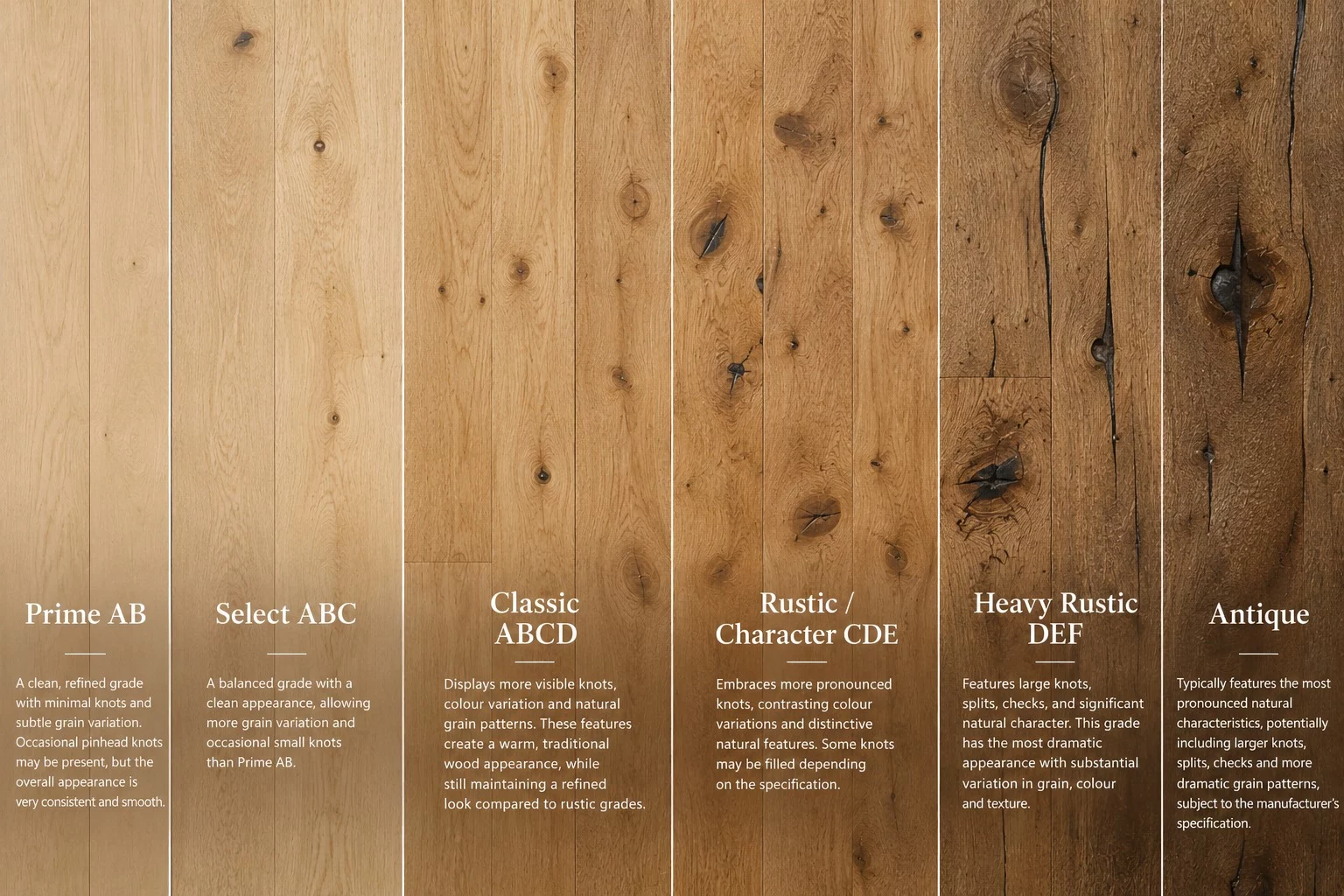
Five grades describe how much natural character the timber carries, from the most controlled to the most expressive. The sixth is a different kind of thing and is shown separately below, because it describes a floor that has been worked on rather than simply sorted.

- Prime AB Cleanest and most uniform
- Select ABC Refined natural character
- Classic ABCD Balanced natural timber
- Rustic / Character CDE Pronounced character
- Heavy Rustic DEF+ Maximum natural variation

Detailed grade comparison
The full Homes and Floors grading reference. Every value below is the definition this house works to, and it is the definition that governs on this page where another manufacturer uses the same word differently.
| Feature | Prime AB | Select ABC | Classic ABCD | Rustic / Character CDE | Heavy Rustic DEF+ | Antique Distressed Custom |
|---|---|---|---|---|---|---|
| Grading code reference | AB | ABC | ABCD | CDE | DEF+ | Custom / Distressed |
| Knot size and quantity | Few or no knots; exceptionally small if present. Maximum 10 mm knots. | Small sound knots permitted, typically up to 15 mm to 20 mm. | Mixed boards, ranging from few knots to larger filled knots. | Large sound knots and dead or unsound knots allowed. | Virtually limitless size and number of sound and broken knots. | Varying sizes of open, filled and broken knots, heavily enhanced to look naturally aged. |
| Sapwood presence | Minimal to none; highly restricted to maintain grain consistency. | Small amounts allowed along the edges of the boards. | Visible but controlled variation between heartwood and sapwood tones. | Significant sapwood permitted, adding natural contrast. | Limitless sapwood allowed; no minimum restrictions across boards. | Allowed without restriction, often shaded or stained to enrich an authentic historical patina. |
| Colour variation | Very low variation; highly uniform tone across planks. | Moderate variation; natural shifts in timber shading are visible. | Natural, controlled tone variation displaying true timber characteristics. | High variation; dramatic natural streaks and dark or light tones. | Maximum colour variation with heavy, contrasting markings. | Intentionally dramatic tonal changes, enriched by deep carbonisation or smoking techniques. |
| Cracks and checks | Strictly not allowed. | Minor surface checks or hairline cracks may be present. | Some filled cracks or checks across growth rings allowed. | End splits, filled cracks and heartwood checks are common. | Heavy checks, deep cracks across growth rings, and noticeable end splits or shakes. | Deeply enhanced grain splits, surface cracks, hand scraped bevels and artificial saw marks. |
| Filler usage | Minimal; only matching colour filler used for tiny imperfections. | Moderate; used neatly to stabilise smaller knots. | Standard; used carefully to neatly secure larger knots or checks. | Heavy; contrasting or matching filler used to accent large knots and cracks. | Heavy and extensive; multi coloured filler is used to complement deep natural cavities. | Artisanal and highly visible; rustic filler mimics centuries of natural wear and repair work. |
| Overall aesthetic | Clean, pristine and modern. | Natural yet refined; balanced. | Classic, natural timber look without being overly wild. | Rustic, traditional and deeply textured. | Maximalist, rugged and heavily aged or reclaimed style. | Deeply historical, hand crafted, beautifully weathered and full of unique character. |
Prime grade, AB
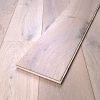
The most controlled face in the range. Boards are sorted so that knots are few or absent and exceptionally small where they do appear, with a maximum of 10 mm. Sapwood is minimal to none, kept back deliberately so the grain reads consistently from board to board. Colour variation is very low and the tone across planks is highly uniform. Cracks and checks are strictly not allowed, and filler appears only as a matching colour touch on tiny imperfections. The result is clean, pristine and modern.
Prime is the grade that lets a floor disappear into the architecture. In a room with a lot going on, a quiet floor is often the right answer. It is worth knowing that sorting to this level uses a smaller share of each log, which is the honest reason Prime usually carries a higher price than a character grade of the same board.
Select grade, ABC
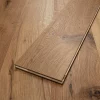
Select keeps the discipline of Prime but lets the timber speak. Small sound knots are permitted, typically up to 15 mm to 20 mm. Small amounts of sapwood are allowed along the edges of the boards. Colour variation is moderate, with natural shifts in shading visible across the floor. Minor surface checks or hairline cracks may be present, and filler is used in moderation to stabilise the smaller knots. The description that fits is natural yet refined.
This is the middle ground most people are actually looking for when they say they want real wood. You can see that it grew, but nothing in it shouts. For a buyer torn between a floor that looks synthetic and one that looks like a barn, Select is usually the grade that settles the argument.
Classic grade, ABCD
Classic widens the range deliberately. A pack holds mixed boards, from quiet ones with few knots through to boards carrying larger filled knots. The contrast between heartwood and sapwood tones is visible but controlled. Colour variation is natural and controlled, displaying true timber characteristics, and some filled cracks or checks across the growth rings are allowed. Filler is standard, used carefully to secure the larger knots or checks neatly. The look is classic and natural without being overly wild.
The mix is the point. Because the boards differ from each other, the floor reads as a floor rather than as a surface, and that effect grows with the size of the room. Classic is also the forgiving choice in a busy household: knots and tonal movement absorb the marks of daily life in a way a uniform floor never does.
Rustic or Character grade, CDE
Rustic opens the door to the features the cleaner grades hold back. Large sound knots are allowed, and so are dead or unsound knots. Significant sapwood is permitted and adds natural contrast across the floor. Colour variation is high, with dramatic natural streaks and dark or light tones. End splits, filled cracks and heartwood checks are common. Filler is used heavily, in a matching or a contrasting tone, to accent the large knots and cracks rather than to hide them. The floor is rustic, traditional and deeply textured.
Nothing in that list is damage. A filled knot in a character grade is a stabilised knot: the filler holds it in place and makes it part of the surface. The grade is chosen by people who want the floor to look like timber that has lived, and it is the most popular grade in period properties for exactly that reason.
Heavy Rustic grade, DEF+
Heavy Rustic is character without a ceiling. The size and number of knots is virtually limitless, sound and broken alike. Sapwood is allowed without a minimum restriction across the boards. Colour variation reaches its maximum, with heavy contrasting markings. Heavy checks, deep cracks across the growth rings and noticeable end splits or shakes are all part of the grade. Filler is heavy and extensive, and multi coloured filler is used to complement deep natural cavities. The intended effect is maximalist, rugged and heavily aged or reclaimed in style.
The filling and stabilising is not a repair of a sub standard board. It is part of how the floor is built: the cavity is filled so that the surface is sound and level, and the filled feature then becomes a visible part of the design. Reading that list as a list of faults is the most common misunderstanding about this grade.
Antique Distressed, custom
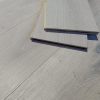
This is the grade that needs the clearest explanation, because two different things are happening at once. Part of what you see is natural: varying sizes of open, filled and broken knots, unrestricted sapwood, and splits and checks in the timber. The rest is made. The knots are heavily enhanced to look naturally aged, the sapwood is often shaded or stained to enrich an authentic historical patina, and the tonal changes are intentionally dramatic and enriched by deep carbonisation or smoking techniques. Grain splits and surface cracks are deeply enhanced, and hand scraped bevels and artificial saw marks may be part of the finish. Filler is artisanal and highly visible, mimicking centuries of natural wear and repair.
So the honest description is a treated floor rather than a sorted one. A hand scraped bevel was cut by a person. A saw mark was applied. A smoked tone is a reaction driven in the timber rather than a colour the tree grew. All of it is legitimate and all of it is deliberate, and it is the reason this grade sits beside the scale rather than at the end of it.
What do AB, ABC, ABCD, CDE and DEF+ mean?
They are the Homes and Floors grading reference. Each added letter marks a step up in the amount of visible natural character the boards may carry: AB is the cleanest sort, ABC allows a little more, ABCD mixes quiet and busy boards, CDE permits large and dead knots with significant sapwood, and DEF+ sets almost no ceiling at all. Read as a sequence they are easy to hold in your head, which is the whole purpose of them.
The formal picture is worth knowing, because it explains why commercial scales exist at all. For engineered boards the applicable European standard is EN 13489, published in the United Kingdom as BS EN 13489. It specifies a classification with three appearance classes, designated by the symbols circle, triangle and square, and it also provides for a classification called the free class, set out in its Annex A. A manufacturer defined grading scale is the free class in practice. Solid hardwood boards are covered by the parallel standard EN 13629, and sawn timber before it becomes flooring is graded under EN 975-1, which applies to boards and strips rather than to a finished floor.
The features that change between grades
Six things vary from one grade to the next. Every row of the comparison table above is one of them, and in plain English they are these.
Sound knots and dead or unsound knots
A sound knot is firmly fixed in the surrounding timber, undecayed, and about as strong as the wood around it. It was a living branch when the tree grew over it, so the fibres are continuous. In a floor it behaves like the rest of the board.
A dead or unsound knot is one that was no longer growing with the tree, or has since been affected by decay. It is not continuous with the surrounding fibres, so it can be loose, ringed with a dark line, or partly open. In flooring that is exactly the kind of feature that gets filled: the cavity is stabilised so the surface stays sound and level, and the filled knot becomes a visible part of the character. The Homes and Floors scale permits dead or unsound knots from Rustic grade upwards, and that permission is deliberate rather than an oversight.
Sapwood and heartwood
In a growing tree, the outer band of wood carries sap and stores nutrients. That is sapwood, and it is typically paler. As the tree ages, the cells in the centre stop conducting and gradually die, forming heartwood, which in oak is darker and in most species is the more durable of the two. That difference in colour is why sapwood shows.
The cleaner the grade, the more sapwood is sorted out, which is why Prime reads as a single tone and Rustic reads as a floor with light and dark areas. One point worth making in plain terms: in flooring, an interior product laid in a dry heated room, the natural durability class that distinguishes heartwood from sapwood is about resistance to fungal decay in exposed conditions. It is not a statement about how well your floor will wear.
Checks, cracks, shakes and splits
These words are used loosely in the trade, and definitions genuinely vary, so it is worth being careful about which distinctions are solid.
For a buyer the practical point is simpler than the vocabulary. In the cleaner grades these features are excluded. From Classic upwards they are permitted and filled, and from Heavy Rustic they can be deep and obvious. A filled check in a character floor is a finished surface, not an unresolved defect.
Does a higher grade mean a better floor?
No, and this is the single most useful thing on this page. Grade describes the face of the board. Quality lives in the things grade says nothing about: the thickness of the wear layer, how the core is built, the moisture content the boards left the factory at, how well they are machined, and the finish on top. A Heavy Rustic board and a Prime board can share every one of those and differ only in how much character was allowed through the sort.
In practice a premium rustic oak floor often costs more than a plain one, because the look is the product. And in a working family kitchen a busier grade is frequently the more practical choice, since knots and colour movement absorb the marks of ordinary life while a uniform floor displays each one.
How to choose the right grade
There is no winner in this list. Work from the look you want and the room it is going into.
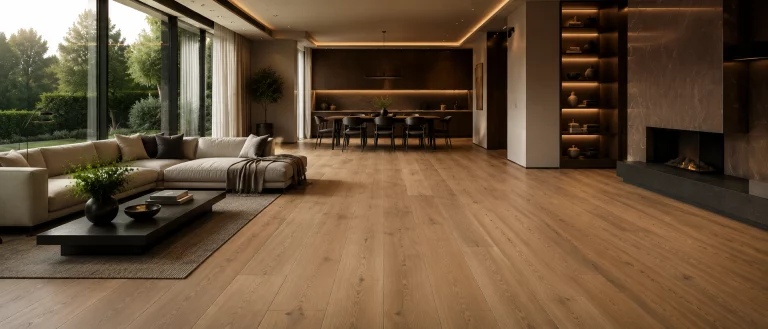
How grading changes the look of a whole room
A sample is one board. A floor is several hundred. That gap is where most disappointment comes from, and it works in both directions: a character grade judged from a single quiet sample looks busier than expected once it is down, and a clean grade judged from one board can look flatter across a large open plan than the customer imagined.
Scale magnifies grade. In a small room a handful of knots reads as detail. Across an open plan the same frequency reads as pattern.
Light decides the contrast. Side light from a window rakes across texture and filled features and makes them far more visible than overhead light does.
Lay from several packs at once. Working from three or four open packs spreads the variation through the room instead of banding one busy run across the middle.
Before you order
Six things worth doing while the decision is still reversible.

