

Samples available UK-wide delivery

Your Cart

0

Your cart is empty

Start with a sample: real cuts of our floors at £1.99 each, sent to your door across the UK.

Subtotal £0.00
Shipping & discounts calculated at checkout
SSL encrypted, safe and secure
Engineered Wood Flooring Cost
Cost guide 7 min read

Engineered Wood Flooring Cost

What engineered oak costs to buy and to fit in the UK, what drives the price within the category, and where the money is better spent.

Start reading
On this page
  1. At a glance
  2. What our engineered wood costs, by wear layer
  3. What actually drives the price within the category
  4. Where the money is better spent
  5. What a complete quote has on it
  6. What makes two quotes impossible to compare
  7. Where the money is quietly lost
  8. Common questions
  9. Who publishes this guide
  10. What the published standards say
  11. Related reading
01

At a glance

Material
Published UK guide figures put the market average around £50/m², with real ranges spanning roughly £28–£55/m² (Factory Direct Flooring). Another guide puts material at £40–50/m² (MyBuilder).
Fitting
Around £20–45/m² for a floating installation. Glue-down costs more — more labour, more adhesive, and a flatter subfloor required.
02

What our engineered wood costs, by wear layer

Every engineered board in our range, grouped by the wear layer that this guide calls the biggest factor in the price. The figure is the price per square metre for a box, as shown on each product card.

Wear layerFloorsFromTypical (median)Up to
2 mm1£22.50 per m²
3 mm35£30.00£39.50£60.00
4 mm13£49.50£49.50£72.50
6 mm8£55.00£55.00£60.00

Prices as listed on 9 November 2026, read from the shop whenever this page is built. They cover the floor itself; underlay, adhesive, preparation, fitting and delivery come on top, and the full cost breakdown lists each of them.

03

What actually drives the price within the category

Wear layer thickness
The single biggest factor, and the one that decides how long the floor lasts. A thicker wear layer means more refinishing cycles. This is where paying more genuinely buys more floor.
Board width
A 220mm plank costs considerably more per square metre than a 125mm one in the same oak. It also needs a flatter subfloor.
Grade
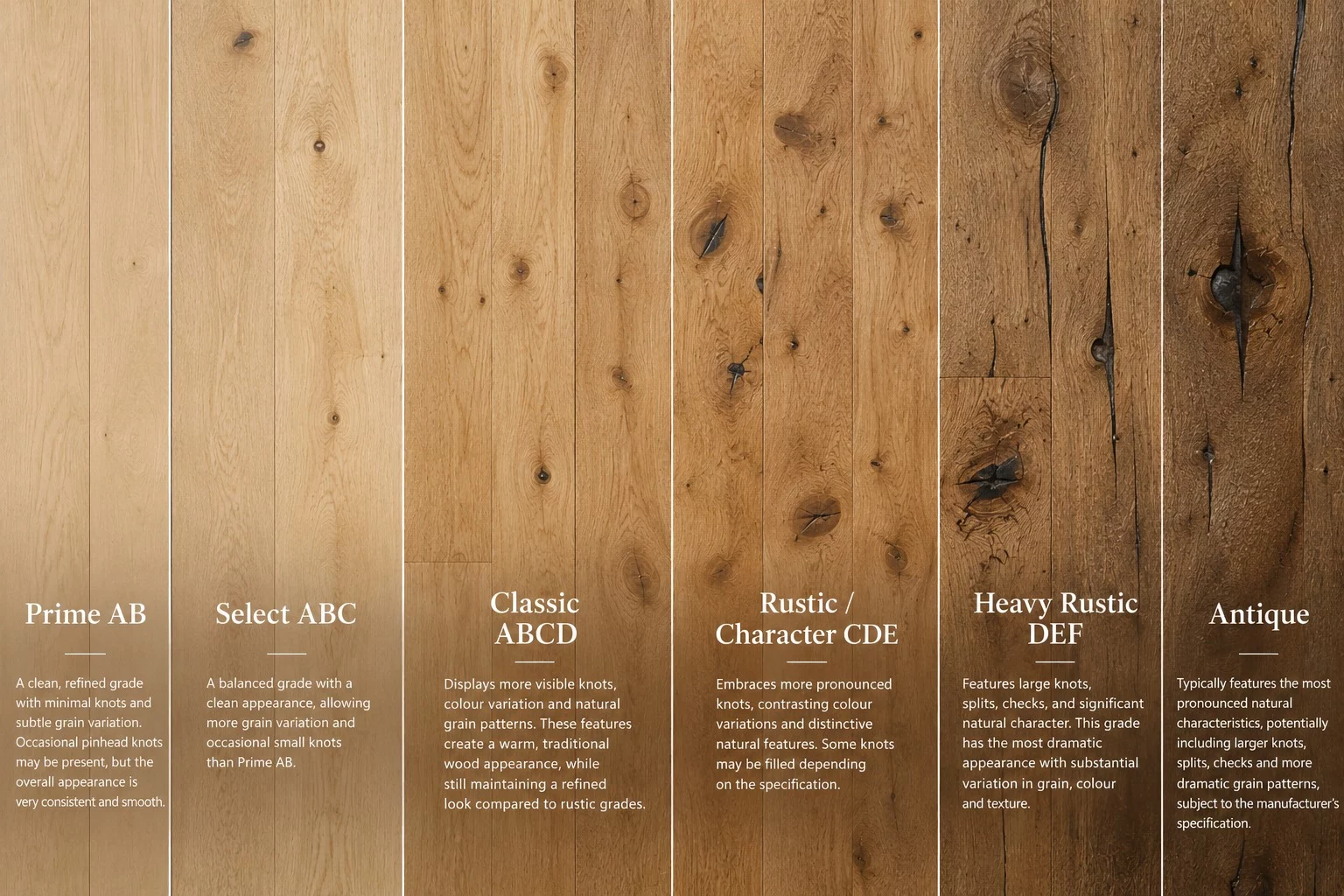
Rustic grades with knots and colour variation cost less than clean, uniform prime grades. This is a taste decision, not a quality one — a rustic floor is not a worse floor. The grading guide sets out what each grade permits.
Finish
Lacquered, oiled, brushed, hand-scraped. Oiled finishes can be repaired in patches rather than resanded whole, which is worth something over twenty years.
See also
04

Where the money is better spent

If the budget is fixed, put it into wear layer before width, grade or finish. Width and grade change how the floor looks on day one. Wear layer changes whether you still have a floor in year fifteen.

And put it into subfloor preparation before the board. A £55/m² floor on an unlevelled subfloor will fail at the joints; a £35/m² floor on a properly prepared one will not.

05

What a complete quote has on it

The figure per square metre is the line everyone compares, and it is the line that decides the least. A quote that can be trusted names the rest of the work as well, and there are six lines to look for.

Subfloor preparation
Levelling compound, or the labour to lift and make good what is there. On an older floor this is the line that moves most between quotes, because it is the one a fitter can only size properly after seeing the room.
Underlay or adhesive
A floating floor needs an underlay, and on a ground floor that underlay usually carries the damp-proof membrane. A glued floor needs adhesive instead, in a quantity that depends on the trowel and the board. One or the other belongs on every quote; neither belongs on both.
Beading, scotia and thresholds
The expansion gap has to be covered, and every doorway needs a threshold. These are small figures that are easy to leave off and impossible to avoid.
Door trimming
A floor plus its underlay raises the finished level. Whether the doors clear it is a question with a yes or no answer, and it is cheaper asked before the floor goes down.
Waste allowance
Ask for the figure for your room rather than applying a rule. Bays, chimney breasts and a pattern floor all raise it, because every perimeter cut produces an offcut that cannot be used elsewhere.
Lifting and disposal
Taking up the old floor and removing it is labour and a skip. A quote that leaves it out is not cheaper than one that includes it.
06

What makes two quotes impossible to compare

Four differences account for most of the confusion. Whether the price is supply-only or supply-and-fit. Whether levelling is included or listed as a provisional extra. Whether the old floor is lifted and taken away. And whether VAT is in the figure. Two quotes that differ on any one of those are not quotes for the same job, and the cheaper one is often the less complete one rather than the better value.

07

Where the money is quietly lost

Not in the board. It is lost when the floor has to come up again, and a floor comes up again for a small number of reasons: it was laid over a subfloor that was not flat, or not dry, or without the acclimatisation the manufacturer asked for. Each of those is a line that costs little at the time and the whole floor afterwards.

Set that order of priorities against current engineered wood prices and the wear layer stops being an abstraction. Two pages carry on from here: engineered against solid, compared, for anyone still weighing the construction itself, and the seven lines in a flooring quote, which puts the board back alongside the subfloor and fitting costs around it.
See also
08

Common questions

Is a thicker wear layer worth paying for?

It is the one upgrade that changes how long the floor lasts rather than how it looks on day one. Width, grade and finish all change the appearance; the wear layer decides how many times the floor can be refinished. On a fixed budget, spend there first.

Why do two boards in the same oak differ so much in price?

Four specifications move independently of each other: wear layer thickness, board width, grade, and finish. A wide, prime-grade, thick-wear-layer board and a narrow, rustic, thin one can both be described as oak engineered flooring and sit a long way apart on price. Compare the four figures, not the description.

Should I spend the money on the board or on the subfloor?

On the subfloor, every time. A board laid over a subfloor that is not flat will fail at the joints whatever it cost, and the failure shows up as movement and noise long before the surface wears. Levelling is the least visible line on a quote and the one least worth deleting.

Delivery and access change what a fit costs, and both depend on where the room is. See the towns and regions we deliver to.
See also
09

Who publishes this guide

Homes and Floors Ltd, registered in England and Wales, company number 11762665, incorporated in January 2019. Endeavour House, Floor 3, Coopers End Road, Stansted CM24 1SJ.

Where a guide quotes a standard or a regulation, the source is named and linked. Product figures come from the specifications on the product pages. If something here is wrong, tell us at info@homesandfloors.com and we will check it.

First published .

10

What the published standards say

Each entry is quoted from its source and linked to it. The full set is in the standards reference.

1 of 2
Kährs

How often a wood floor can be sanded

up to 4 times sanding cycles, engineered wood floor (manufacturer statement)

No trade-association or standards source found puts a number on how often an engineered wood floor can be sanded; the only sourced figure comes from a manufacturer, Kährs, which says engineered floors can be sanded up to four times depending on wear-layer thickness.

The exact wording

“Depending on the thickness of the wear layer, they can be sanded up to four times, extending their lifespan significantly.”

Source: FAQ about flooring - Kährs
British Standards (BSI)

BS EN 13489 — multi-layer parquet

BS EN 13489 is the product standard for multi-layer parquet elements, setting out their characteristics, requirements and test methods for internal use as flooring.

The exact wording

“This document specifies the characteristics, requirements and test methods of multi-layer parquet elements for internal use as flooring.”

Source: BS EN 13489:2023 - Wood-flooring and parquet. Multi-layer parquet elements
Your next step
Put the figures against a real board
Order samples of the floors you are pricing and compare them in the room the quote is for.
  • Samples £1.99 each
  • UK-wide delivery
  • Advice before you order

Join the Homes & Floors Club

New ranges and offers. Hear it first.

  • Room ideas & honest guides
  • New floors first
  • Special offers

No spam. Unsubscribe any time.