


Where the Oak Comes From: Sourcing, Certification and the Law
The UK Timber Regulation, what a chain-of-custody certificate does and does not say, the species named on the range's boards, and what to ask before ordering.
An oak floor arrives as boards in boxes, and the question of where the tree grew and who checked that it was cut legally is answered, if at all, in paperwork the boxes do not show. This guide sets out what the law requires of whoever first brought the timber into the UK, what a certificate does and does not mean, what the range's listings actually state, and the questions worth asking before you order.
On this page
- The law: due diligence before the timber is sold
- What FSC and PEFC chain-of-custody certificates say
- What the listings in the range say
- What the product standards do cover
- The questions to ask before ordering
- Why this matters for a floor that should last
- Common questions
- What the published standards say
- Who publishes this guide
The law: due diligence before the timber is sold
Anyone who places timber or timber products on the UK market for the first time is an operator under the assimilated Regulation (EU) No 995/2010, known as the UK Timber Regulation, and placing illegally harvested timber on the market is prohibited. The operator must exercise due diligence, and Article 6 of the regulation says what that consists of: access to information about the supply, procedures for assessing the risk that the timber was harvested illegally, and procedures for mitigating that risk unless it is negligible. An engineered oak board is a timber product, so the importer who first brought it into the country holds that record. A retailer further down the chain is not the operator, and the record sits with whoever was.
What this means for a buyer is that legality is not a certificate you look for on the box. It is an obligation on the importer, enforced by a regulator, and the question to ask a seller is not "is this legal" but "who imported it, and can they show the due-diligence record if asked".
What FSC and PEFC chain-of-custody certificates say
A chain-of-custody certificate confirms that the certified company controls certified material along its supply chain: that it sources from certified forests, recycled or controlled sources and follows the scheme's procedures through production and distribution. What it does not confirm is that every product the company makes contains certified material. Only products carrying the on-product label or claim do. A manufacturer can hold a chain-of-custody certificate and sell a board that carries no claim; the certificate is about the company's system, the claim is about the board.
So the two questions are separate. "Is the maker certified" is a question about a company. "Is this board sold with a certified claim" is a question about a product, and it is the second that puts certified oak in your floor. When a listing or a datasheet says "FSC certified", look for whether the claim is attached to the product, with the certificate code, or to the company in general.
What the listings in the range say
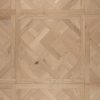
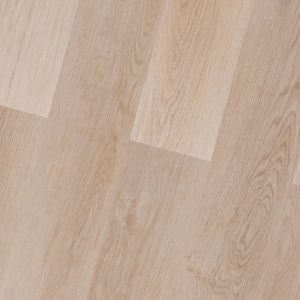
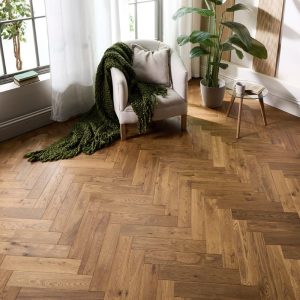
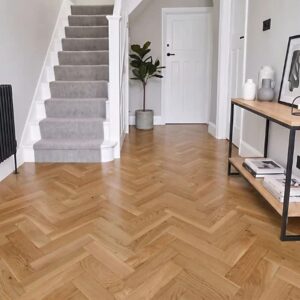
The listings name the species and the construction, and they do not name a forest or a factory. On the 33 engineered boards the species named is European oak on 31 and American black walnut on two; on all fifteen parquet floors, the herringbone blocks, chevron blocks and Versailles panels, it is European oak; and on all fifteen solid boards and blocks it is European oak in rustic grade. Where a country of manufacture is stated it is on other categories: the eleven porcelain tiles are made in Spain and the five wall panels in Belgium. For the oak, the listings do not state it, and this guide does not guess.
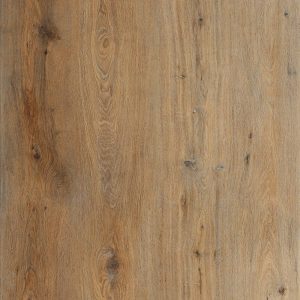
"European oak" is a species description rather than an origin. It covers the oaks native to Europe, grown across a wide belt of the continent, and it distinguishes the timber from American white oak and from tropical hardwoods. It says the tree was a European oak; it does not by itself say where it grew or where the board was made.

What the product standards do cover
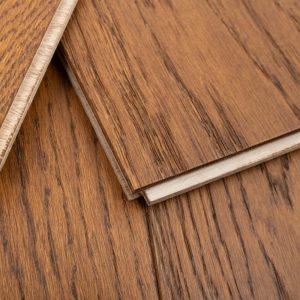
The standards behind an oak floor are about the board, not its origin. EN 13489 is the product standard for multi-layer parquet elements, and every engineered board and block in the range is one of those: an oak wear layer bonded to a cross-laminated core, with a 3 mm, 4 mm or 6 mm wear layer stated on the listing. EN 13226 covers solid parquet elements with grooves and tongues, which is what the 18 mm solid boards and blocks are. EN 14342 defines the characteristics and test methods of wood flooring and parquet for internal use and sets the rules for marking and evaluating conformity, which is the standard behind a wood floor's declaration of performance. None of the three names a country.
What the standards do fix is the state the timber arrives in. EN 13489 requires the moisture content of a multi-layer parquet element to be between 5 and 9 per cent at the time of first delivery, measured by the oven-dry method of EN 13183-1. The corresponding figure for solid parquet under EN 13226 was not available from a source we could read, so it is not stated here. Moisture at delivery is the property that decides whether a board settles or moves after it is laid, and the moisture and humidity guide follows it into the room.
The questions to ask before ordering
Why this matters for a floor that should last
An oak floor is bought for decades, and the cross-bonded core of an engineered board is what lets it stay flat where a solid board would move. The origin of the oak does not change that arithmetic; the moisture at delivery, the wear layer and the fitting do. Sourcing is worth asking about because a buyer is entitled to know, and because a seller who can answer it usually keeps the rest of the paperwork in order too. It is not the property that decides whether the floor is right for the room, and this guide has tried not to pretend otherwise.
Common questions
Does an FSC certificate mean the oak in my floor is certified?
Only if the product itself carries the FSC label or claim. A chain-of-custody certificate confirms that the company controls certified material along its supply chain; it does not mean every product it makes contains certified material.
Who is responsible for the timber being legally harvested?
The operator: whoever placed the timber or timber product on the UK market for the first time. Under the UK Timber Regulation that operator must exercise due diligence, with access to information, a risk assessment and risk mitigation unless the risk is negligible.
Where does the oak in the range come from?
The listings name the species, European oak on the boards, blocks and panels and American black walnut on two engineered boards, and do not name a country of growth or manufacture. This guide does not state one it cannot source; ask before ordering, and the importer's record is where the answer sits.
Does the species decide how the floor behaves?
Less than the construction and the moisture at delivery do. EN 13489 requires 5 to 9 per cent moisture in a multi-layer parquet element at first delivery, and it is the gap between the board and the room, not the forest, that decides whether a floor settles or moves.
Whether a house has a suspended timber ground floor or a screed decides how an oak board is fixed, and that depends on when and where it was built. Browse by town and region.

What the published standards say
Who publishes this guide
- Samples £1.99 each
- UK-wide delivery
- Advice before you order