













Samples available UK-wide delivery

Your Basket

0

Your basket is empty

Browse our editorial collections and find your perfect floor.

Browse Collections
Subtotal £0.00
Shipping & discounts calculated at checkout
SSL encrypted — safe and secure
Engineered Wood Flooring Thickness: 12 to 20 mm
How to choose 5 min read

Engineered Wood Flooring Thickness: 12 to 20 mm

What 14, 15, 18 and 20 mm engineered boards are made of, what thickness changes over joists and underfloor heating, and why the wear layer matters more.

Guide type
How to choose
Reading time
5 min
Sanding cycles
up to 4 times
Max. resistance over UFH
0.15 m2K/W

Engineered oak is sold by thickness first, and the number is easy to over-read. A thicker board is not automatically a better one; it is a different construction for a different job. The engineered floors in our range come in five thicknesses: 14 mm in 44 cases, 18 mm in 8, 15 mm in 6, 20 mm in 6 and 12 mm in one. This guide explains what the total thickness is made of, what it changes, and where the wear layer and the width matter more.

1/ 10
01

What the thickness is made of

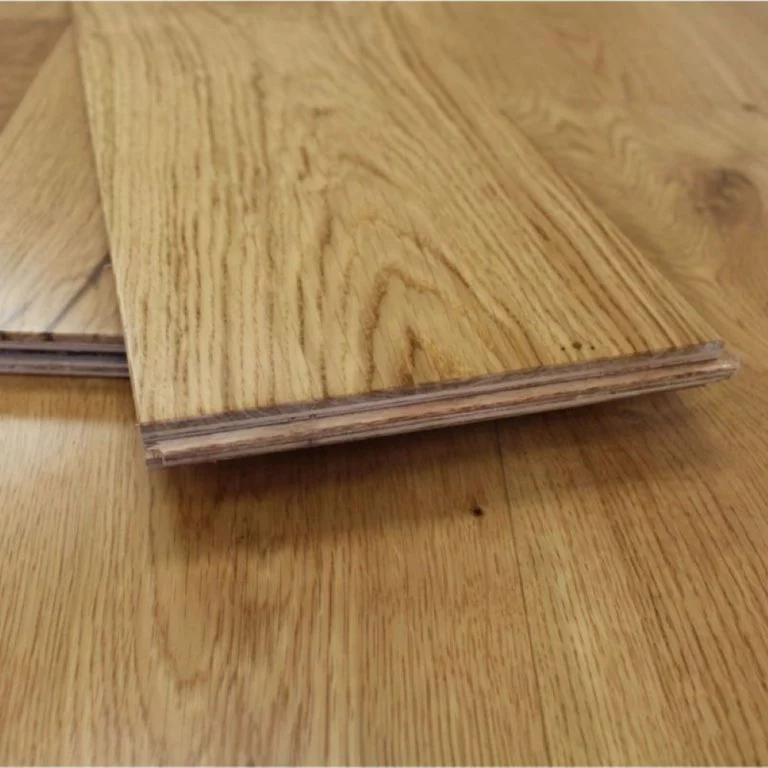
An engineered board is a layer of oak bonded to a core whose layers run across each other. Its product standard is BS EN 13489, the standard for multi-layer parquet elements, which defines the oak on top as a solid wood top layer of at least 2.5 mm thickness. The total thickness is that wear layer plus the core. The Wood Handbook of the US Forest Products Laboratory explains why the core is built crosswise: by adhering wood in crossing directions, such as plywood, the product has much lower swelling and shrinkage with changes in humidity or moisture. The thickness tells you how much board there is; the wear layer tells you how much of it is oak you can sand.

02

The five thicknesses in the range

14 mm
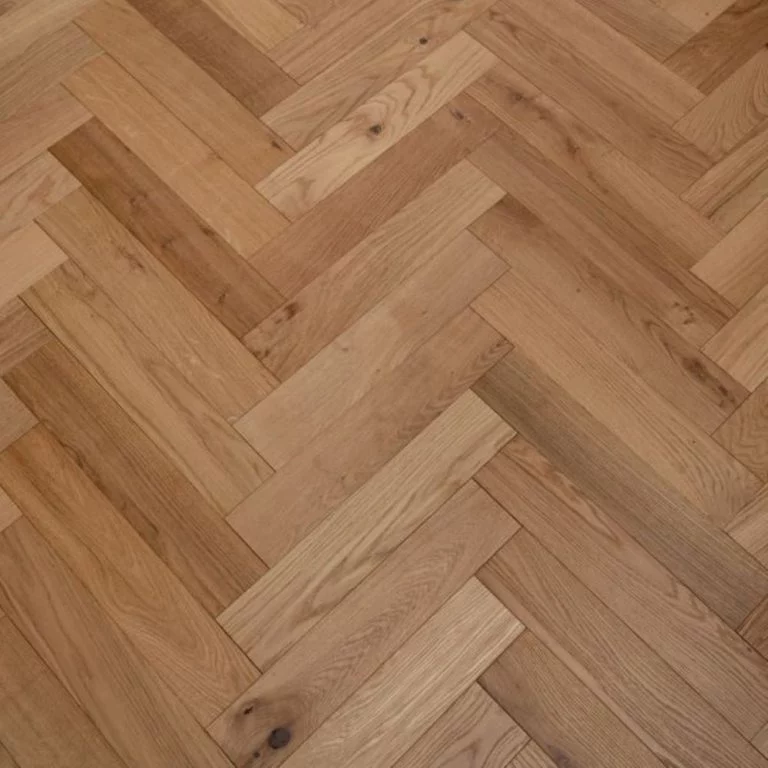
The everyday thickness: 44 floors, 30 planks at 125, 150 and 190 mm wide and 14 herringbone and chevron blocks. All but one carry a 3 mm oak wear layer; one walnut plank does not list a wear layer.
15 mm
6 floors, the 4 Victorian Antique planks and 2 Amersham herringbone floors, all with a 4 mm wear layer.
18 mm
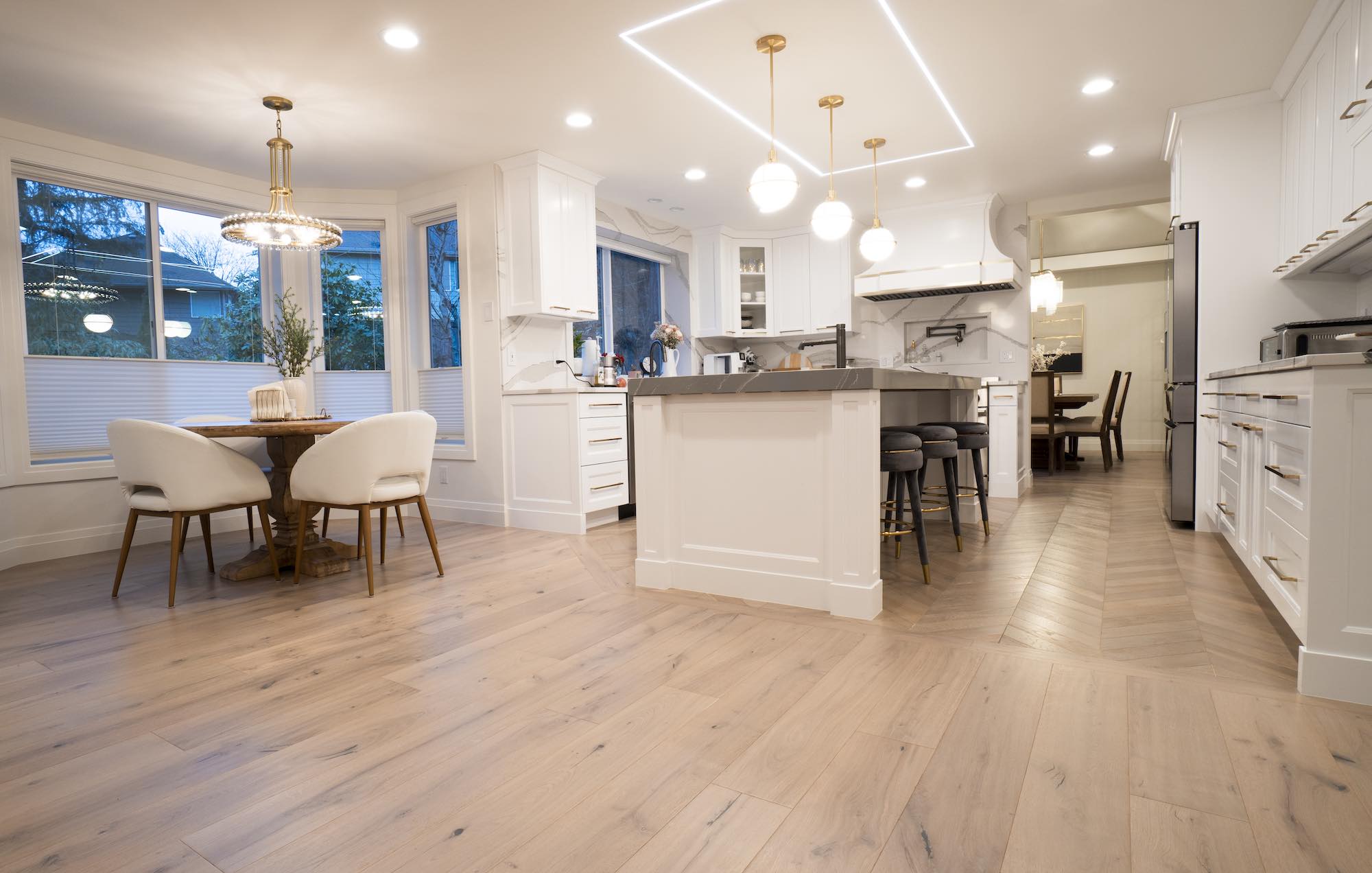
8 floors, all herringbone blocks: 4 Cambridge with a 4 mm wear layer and 4 Oxford with 3 mm. The 18 mm oak page sets them next to the solid oak floors of the same thickness.
20 mm
6 floors: 3 planks with a 6 mm wear layer and 3 Versailles panels with 4 mm.
12 mm
One plank, with a 2 mm wear layer.
See also
03

Thickness and the wear layer are different numbers

Read together, the list shows that thickness does not decide the wear layer. At 18 mm there are 3 mm and 4 mm layers; at 20 mm, 4 mm and 6 mm. It is the wear layer that decides how many times a floor can be sanded, and the only sourced figure for that comes from a manufacturer, Kährs, which says engineered floors can be sanded up to four times depending on the thickness of the wear layer. If refinishing over decades is the point, compare wear layers, not total thickness.

See also
04

Thickness over joists and battens

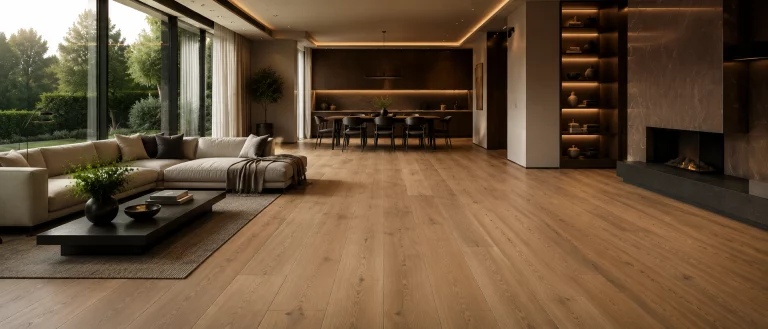
Where the floor goes over joists or battens rather than a screed, thickness becomes structural. BEAMA, the UK underfloor heating trade association, advises in its guidance on floors over heating that, unless installed over a screeded slab, engineered boards of less than 20 mm thickness should be supported and fixed to an additional decking material, unless the manufacturer specifically states otherwise. In our range 59 of the 65 engineered floors are thinner than 20 mm. BEAMA also describes engineered timber as something that can be laid as a floating floor or nailed into battens or joists; which of those a particular board allows is set by its fitting instructions.
See also
05

Thickness over underfloor heating

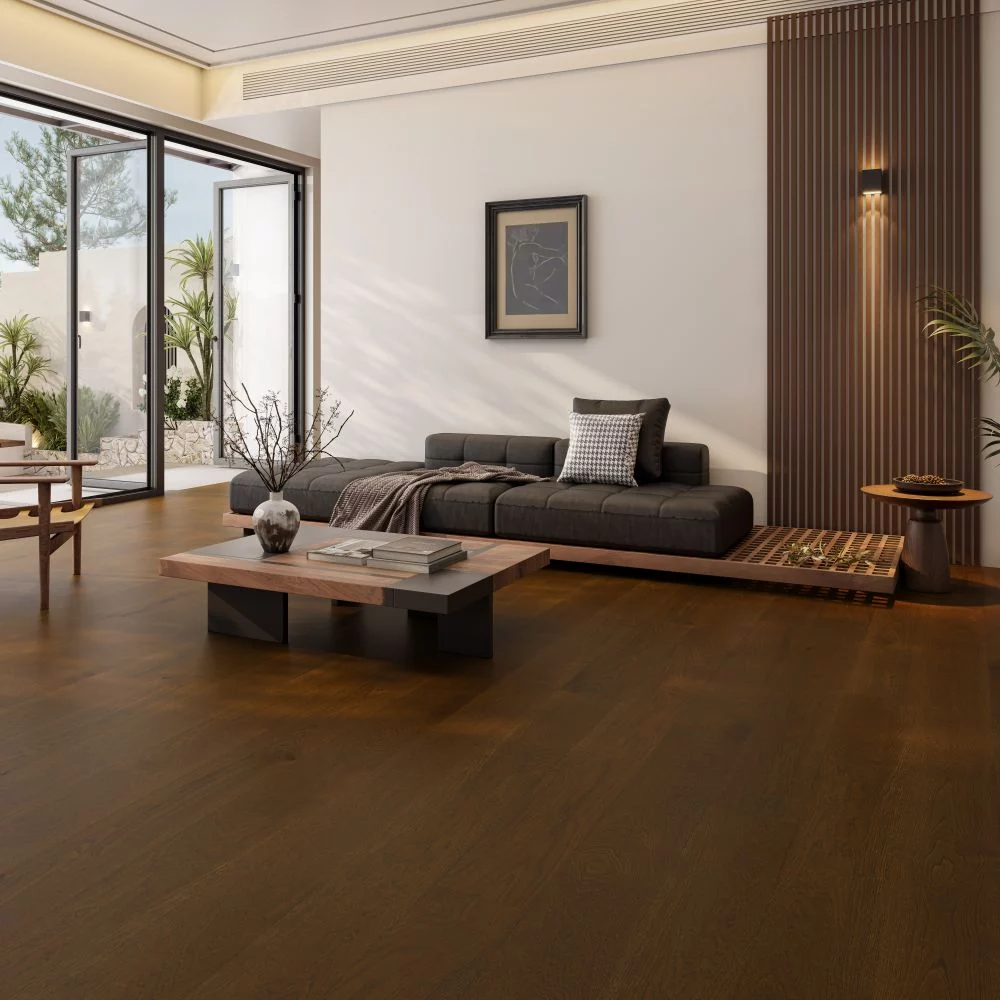
Every engineered floor in our range is listed as compatible with underfloor heating, at every thickness. What thickness changes is how much heat the floor holds back. Floor coverings over a water-based system are normally limited to 0.15 m²K/W, and Junckers, a maker of hardwood floors, publishes the figures for its own boards: 0.08 m²K/W at 14 mm, 0.09 at 15 mm and 0.12 at 20.5 mm. Those are one manufacturer's numbers, not a property of every board, but they show the direction: a thicker board leaves less of the allowance for the underlay.
See also
06

Thickness, doors and thresholds

A floor's height is its own thickness plus whatever goes under it. When an old floor comes up and a new one goes down, the difference shows at door bottoms, thresholds and wherever the floor meets another room. Measure the whole build-up, board and underlay or adhesive, before choosing the thickness rather than after the boards arrive.

07

Width is the other dimension

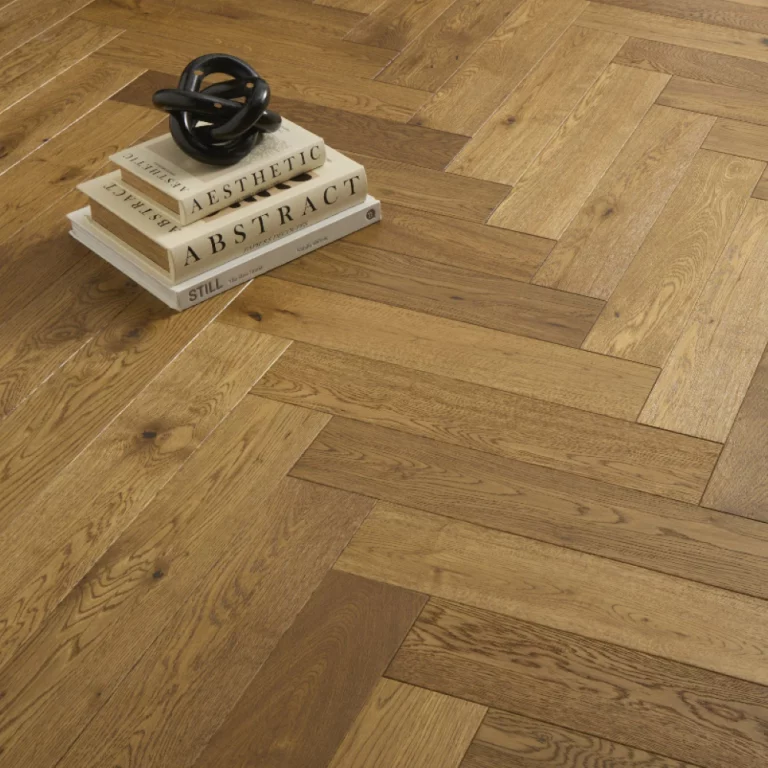
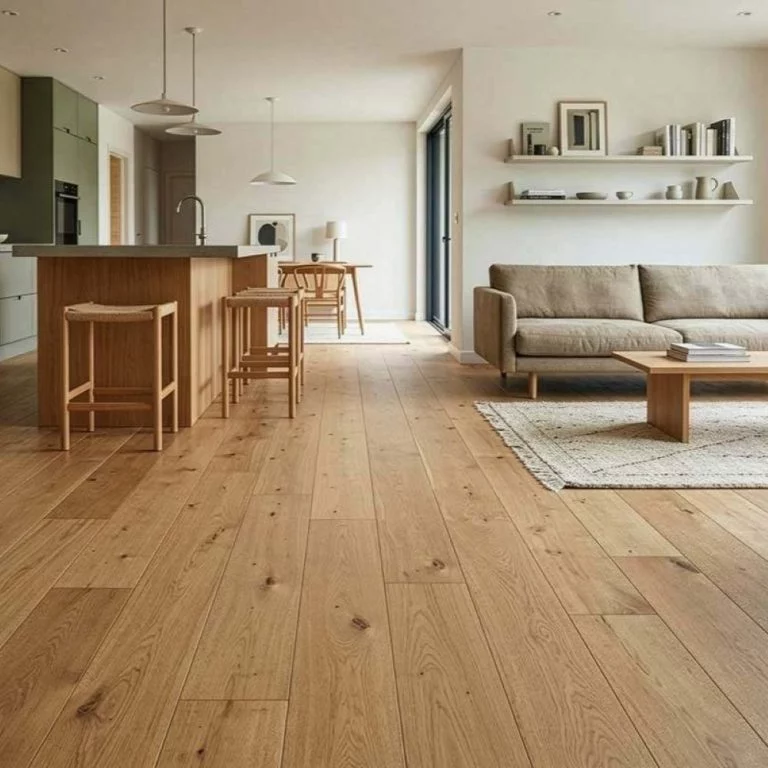
Thickness is rarely what changes the look of a room; width is. Wood moves mostly across its width: the Handbook says it shrinks and swells most in the direction of the growth rings and only slightly along the grain. The wide plank page gathers the engineered boards from 190 mm up, and the guide to wide and narrow planks covers what width does to a room and to the way a floor moves.
See also
08

Common questions

What thickness of engineered wood should I choose?

For most rooms over a screed, the 14 mm boards that make up most of our range, 44 of the 65 engineered floors. Go thicker for a reason: a particular herringbone block, a thicker wear layer, or a floor over joists, where BEAMA advises an additional deck under engineered boards thinner than 20 mm.

Is 14 mm engineered wood thick enough?

Over a flat screed, yes: it is the thickness of 44 of our 65 engineered floors, almost all with a 3 mm oak wear layer. Over joists or battens, BEAMA advises fixing engineered boards thinner than 20 mm to an additional deck unless the manufacturer states otherwise.

Is 20 mm engineered wood better than 14 mm?

Not better, different. Our 20 mm floors carry a 4 or 6 mm wear layer against 3 mm on most 14 mm boards, and at 20 mm BEAMA's rule for an additional deck over joists no longer applies. Over underfloor heating it holds back more heat: on Junckers' published figures 0.12 m²K/W at 20.5 mm against 0.08 at 14 mm.

Does thickness matter for underfloor heating?

Not for compatibility: all 65 engineered floors in our range are listed as compatible. It matters for heat output, because a thicker board takes more of the 0.15 m²K/W normally allowed for the floor covering, leaving less for the underlay.

Is the wear layer the same as the thickness?

No. The thickness is the whole board; the wear layer is the oak on top. At 18 mm our range has 3 mm and 4 mm wear layers, at 20 mm 4 mm and 6 mm. The wear layer decides how often the floor can be sanded.

Every product page states thickness, width, length and wear layer. We deliver engineered oak town by town across the UK. Browse by town and region.


See also
09

What the published standards say

Each entry is quoted from its source and linked to it. The full set is in the standards reference.

BS EN 13489 — multi-layer parquet

BS EN 13489 is the product standard for multi-layer parquet elements, setting out their characteristics, requirements and test methods for internal use as flooring.

“This document specifies the characteristics, requirements and test methods of multi-layer parquet elements for internal use as flooring.”

Source: BS EN 13489:2023 - Wood-flooring and parquet. Multi-layer parquet elements

Multi-layer parquet: a top layer of at least 2.5 mm

EN 13489, the product standard for multi-layer parquet, defines multi-layer parquet as a wood flooring system of laminated construction with a solid wood top layer of at least 2.5 mm, and requires the top layer never to be thinner than 2.5 mm, whatever the production deviation.

Minimum top layer thickness, multi-layer parquet (EN 13489:2023, 3.1 and Table 1)2.5 mm

“wood flooring system of laminated construction with a solid wood top layer of at least 2,5 mm thickness … Due to process in production, the deviation of declared top layer thickness can be ± 0,2 mm but the thickness shall be never less than 2,5 mm.”

Source: EN 13489:2023 - Wood-flooring and parquet - Multi-layer parquet elements (SIST preview of the standard, clause 3.1 Terms and definitions, clause 4.1.3 Dimensional characteristics)

Why wood bonded crosswise moves less

The Wood Handbook of the US Forest Products Laboratory says that bonding wood in crossing directions, as in plywood, gives a product with much lower swelling and shrinkage when humidity or moisture changes.

“Another benefit of adhesives is that by adhering wood in crossing directions, such as plywood, the product has much lower swelling and shrinkage with changes in humidity or moisture.”

Source: Wood Handbook — Wood as an Engineering Material, General Technical Report FPL-GTR-282 (2021), chapter 10 "Wood Adhesives—Bond Formation and Performance", section "Bond Formation", page 10–1 — USDA Forest Service, Forest Products Laboratory

How often a wood floor can be sanded

No trade-association or standards source found puts a number on how often an engineered wood floor can be sanded; the only sourced figure comes from a manufacturer, Kährs, which says engineered floors can be sanded up to four times depending on wear-layer thickness.

sanding cycles, engineered wood floor (manufacturer statement)up to 4 times

“Depending on the thickness of the wear layer, they can be sanded up to four times, extending their lifespan significantly.”

Source: FAQ about flooring - Kährs

Engineered boards under 20 mm over joists or battens

Unless installed over a screeded slab, engineered boards of less than 20 mm thickness should, according to BEAMA, be supported and fixed to an additional decking material for structural support, unless the manufacturer specifically states otherwise.

board thickness below which extra decking is advised (not over a screed)20 mm

“Unless installed over a screeded slab, engineered boards of less than 20mm thickness should be supported and fixed to an additional decking material to lend suitable structural support unless specifically stated”

Source: BEAMA Underfloor Heating — Choosing your floor covering to maximise your underfloor heating efficiency (April 2020)

Engineered timber over underfloor heating: floating or nailed

BEAMA, the UK underfloor heating trade association, describes engineered timber as a more stable option than solid timber because it is cross-laminated, so that its moisture content is less critical, and says it can be laid directly over underfloor heating as a floating floor or nailed into battens or joists.

“Engineered timber – A more stable option than solid timber, due to being cross-laminated, its moisture content is less critical. It can be laid directly over the underfloor heating as a ‘floating floor’ or nailed into battens or joists.”

Source: BEAMA Underfloor Heating — Choosing your floor covering to maximise your underfloor heating efficiency (April 2020)

Thermal resistance of the floor covering

Floor coverings over a warm water underfloor heating system are normally limited to a thermal resistance of R(λ,B) ≤ 0.15 m2K/W, which is also the worst permissible case used for system dimensioning in dwellings.

maximum thermal resistance of floor covering (R lambda,B)0.15 m2K/W

“The following types of floor coverings can be laid on Uponor surface heating/cooling systems if a maximum thermal resistivity of Rλ,B ≤ 0,15 m²K/W is observed and approved by the manufacturer”

Source: Uponor underfloor heating/cooling — Planning information (Technical Information TI-1186660)

Thermal resistance of wood boards by thickness

Junckers gives the thermal resistance of its wood floorboards as 0.08 m2K/W at 14 mm, 0.09 at 15 mm, 0.12 at 20.5 mm and 0.13 at 22 mm, adds the underlay to the board, and works the example of a 14 mm board on its PolyFoam underlay (0.07) to a total of 0.15 m2K/W.

14 mm floorboards0.08 m2K/W
15 mm floorboards0.09 m2K/W
20.5 mm floorboards0.12 m2K/W
22 mm floorboards0.13 m2K/W
Junckers PolyFoam underlay0.07 m2K/W
Junckers Foam underlay0.04 m2K/W

“22 mm floorboards: 0.13 20.5 mm floorboards: 0.12 15 mm floorboards: 0.09 14 mm floorboards: 0.08 Intermediate layer: Junckers PolyFoam, incl. extra 0.20 mm PE membrane: 0.07 Junckers Foam: 0.04 … Example: 14 mm clip system laid on PolyFoam, the total insulation is: md = 0.08 + 0.07 = 0.15 m² °K/W.”

Source: Junckers — Underfloor Heating, General Information (technical data sheet E 4.0)

Swelling, shrinking and gaps in flooring

The Wood Handbook of the US Forest Products Laboratory says that below fibre saturation wood swells as it gains moisture and shrinks as it loses it, that this can cause warping, checking and splitting and, among other problems, gaps in flooring, and that wood moves most in the direction of the growth rings, about half as much across them and only slightly along the grain.

“Below MCfs, wood changes dimension as it gains moisture (swells) or loses moisture (shrinks) because the volume of the cell wall depends on the amount of bound water. This shrinking and swelling can result in warping, checking, and splitting of the wood, which in turn can lead to decreased utility of wood products, such as loosening of tool handles, gaps in flooring, or other performance problems. … It shrinks (swells) most in the direction of the annual growth rings (tangentially), about half as much across the rings (radially), and only slightly along the grain (longitudinally).”

Source: Wood Handbook — Wood as an Engineering Material, General Technical Report FPL-GTR-282 (2021), chapter 4 "Moisture Relations and Physical Properties of Wood", section "Dimensional Stability", page 4–7 — USDA Forest Service, Forest Products Laboratory
10

Who publishes this guide

Homes and Floors Ltd, registered in England and Wales, company number 11762665, incorporated in January 2019. Endeavour House, Floor 3, Coopers End Road, Stansted CM24 1SJ.

Where a guide quotes a standard or a regulation, the source is named and linked. Product figures come from the specifications on the product pages. If something here is wrong, tell us at info@homesandfloors.com and we will check it.

First published .

Still deciding?
A sample on the floor, in the room it is for, answers most of what a description cannot.
Newsletter

New ranges and offers. Hear it first.

Unsubscribe anytime